1. What is concrete reinforcement fiber?
In high-performance construction, the difference between success and structural failure often lies in the micro-matrix of the materials used. Common challenges such as shrinkage cracks, surface hollowing, or poor workability in thin-layer applications are typically the result of internal stresses within the mortar. Celotech addresses these critical issues through Celofiber®, a specialized dual-line fiber technology comprising Polypropylene (PP) Fiber and Cellulose Fiber.
2. Technical breakdown: specialized functional roles
Celofiber® isn’t just an additive; it’s a structural enhancement system designed to provide targeted solutions for various mortar formulations.
2.1 Celofiber® PP Fiber: The High-Tensile “Micro-Skeleton”
Material Science: Composed of 100% virgin polypropylene synthetic polymer, ensuring exceptional alkali resistance and long-term chemical stability.
Physical Form: Available in precision-cut lengths from 3 mm to 60 mm. The monofilament surface is engineered for high-speed dispersion and maximum tensile bond.
Core Mechanism: Upon mixing, the fibers form a dense, three-dimensional reinforcement network. This “micro-mesh” intercepts micro-cracks before they propagate, effectively absorbing shrinkage stress and external kinetic loads.
Value Proposition: Maximizes crack resistance and matrix toughness, making it indispensable for high-load or high-traffic environments.
It is engineered from 100% pure PP synthetic polymer, this series acts as the structural reinforcement of the construction matrix. We have further refined this line to meet specific intensity requirements:
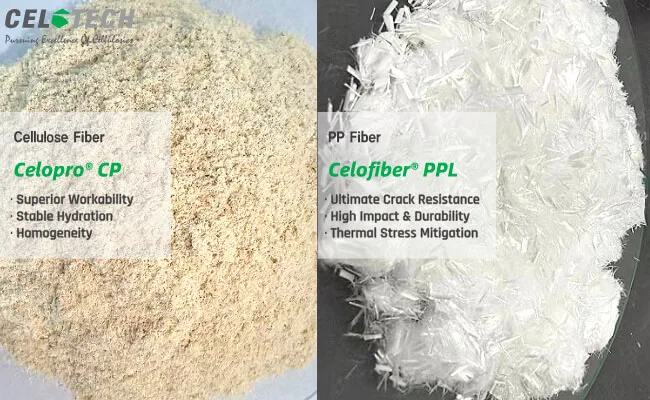
Celofiber® PPL (Fine Monofilament): Featuring a smooth surface and high tensile strength, PPL disperses uniformly to create a dense, three-dimensional network. It acts as “micro-reinforcement” that carries shrinkage stress and intercepts micro-cracks before they propagate. It is the ideal choice for anti-crack mortars, wall putty, and decorative plasters.
Celofiber® PPM (Enhanced/Mesh Series): Designed for maximum mechanical anchoring. PPM significantly boosts impact resistance and matrix toughness. It is indispensable for heavy-duty applications such as industrial factory floors, parking garages, and structural repair mortars that must withstand external loads and abrasion.
2.2 Celofiber® Cellulose Fiber: The Intelligent “Water-Locking” Matrix
Material Science: Derived from premium natural wood sources through specialized thermo-mechanical processing, offering a sustainable, eco-friendly solution.
Physical Form: A fine, flocculent fiber structure with a high surface area (lengths 60–1000 microns).
Core Mechanism: The fibers leverage natural capillary action to provide unparalleled water retention. This ensures that moisture stays within the mortar long enough for complete cement hydration, significantly reducing drying-shrinkage.
Value Proposition: Enhances workability, thixotropy, and anti-sagging properties, ensuring smooth application even in vertical or overhead scenarios.
Made from selected natural wood through specialized thermo-mechanical processing, our Cellulose fibers—specifically the CP Series—represent an eco-friendly approach to rheology management.
Celofiber® CP Series: These fine, flocculent fibers (ranging from 60 to 1000 microns) feature a rough surface with massive adsorption capacity. By leveraging natural hydrophilicity, the CP series provides excellent water retention, ensuring moisture remains for complete cement hydration.
Core Value: The interlocking fibers increase mortar cohesion and consistency. This delivers superior anti-sagging and thixotropic properties, which are central to optimizing workability in tile adhesives, joint fillers, and spray-applied mortars.
3. How to choose the right fiber for your project?
Proper selection depends on the specific performance requirements of your project.
3.1 Engineering Scenarios for Celofiber® PP Fiber
Heavy-Duty Infrastructure: Industrial factory floors, parking garages, and high-traffic pavements.
Structural Repair: Bridge decks, waterproof layers, and structural strengthening mortars.
Thermal Defense: Exterior Insulation and Finish Systems (EIFS/ETICS) where thermal expansion stress is a constant threat.
3.2 Functional Scenarios for Celofiber® Cellulose Fiber
High-Bond Applications: Premium tile adhesives and joint fillers requiring anti-slip performance.
Plastering & Rendering: Gypsum-based or cement-based plasters where a smooth, crack-free finish is required.
Specialty Mortars: Spray-applied (shotcrete) or pumpable mortars where stability and homogeneity are critical.
3.3 The Synergistic Approach
For advanced systems, such as high-performance exterior wall renders, Celotech recommends a dual-fiber synergy. Cellulose Fiber manages the initial workability and hydration phase, while PP Fiber provides the secondary reinforcement for long-term mechanical durability.
4. Technical specifications & dosage
| Product Series | Material Base | Typical Length | Recommended Dosage |
| Celofiber® PP | Polypropylene | 3mm – 19mm (Standard) | 0.6 – 1.2 kg/m³ |
| Celofiber® Cellulose | Natural Wood | 60μm – 1000μm | 0.1% – 0.4% (Dry Mix) |
Note: Custom fiber lengths are available upon request to meet specific engineering requirements.
5. Quality you can trust
At Celotech, our commitment to precision ensures that every batch of Celofiber® meets rigorous international standards for dispersion and purity. We provide technical documentation and lab support to help you optimize your formulations for maximum cost-efficiency and performance.
Redefine your mortar performance. Choose Celofiber® by Celotech.