How to Design, Optimize and Produce High-Performance Wall Putty
Developing a high-quality wall putty is not simply a process of mixing cement, fillers, and additives together.
If you manufacture wall putty, your real challenge is creating a formulation that performs consistently under different conditions such as raw material batches, substrates, climate s and application methods.
A successful wall putty must achieve a balance between strength, flexibility, workability, and durability. Increasing one component does not always improve overall performance. In many cases, improving one property may negatively affect another. Therefore, the best formulation is making each component work together effectively.
1. What Makes a High-Performance Wall Putty?
Before optimizing your formula, you have to define what performance your project actually require. Different applications have different priorities. For example, interior wall putty focuses more on smooth application and surface finish, while exterior wall putty requires stronger durability and resistance to environmental stress. A good wall putty formulation is always a balance between below factors.
| Performance Requirement | Why It Matters | Main Factors Influencing Performance |
| Adhesion | Ensures the putty remains bonded to the substrate | Binder system, polymer modification, curing |
| Workability | Determines application experience | Cellulose ether, rheology, water demand |
| Water Retention | Supports proper hydration and curing | Cellulose ether selection and dosage |
| Crack Resistance | Improves long-term durability | Flexibility, shrinkage control, formulation balance |
| Surface Finish | Affects painting quality | Filler selection, particle size, rheology |
| Production Consistency | Ensures stable commercial quality | Raw materials, mixing process, QC control |
 2. Different Types of Wall Putty
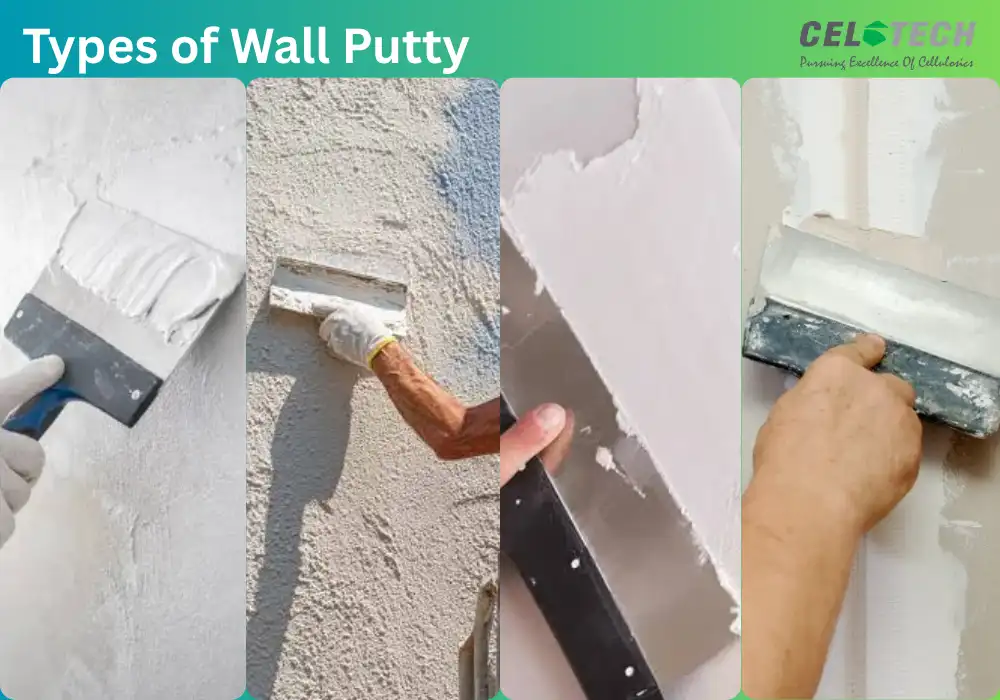
After confirm what performance your project needs, then you should identify what type of wall putty you are producing.
| Wall Putty Type | Typical Application | Main Formulation Focus |
| Interior Cement-based Wall Putty | Indoor walls before painting | Smoothness, workability, surface finish |
| Exterior Wall Putty | Outdoor walls exposed to weather | Adhesion, flexibility, durability |
| Premium Skim Coat | High-quality finishing applications | Fine texture, leveling, appearance |
| Gypsum-based Putty | Dry interior applications | Setting behavior, smoothness, crack control |
According to the sheet, you can decide which factor should prioritize to potimize: water retention, polymer modification, rheology control and surface quality, and keep in mind: A formulation can’t be totally used well in another new market.
3. Main Components of Wall Putty
A cement-based wall putty formulation usually contains several functional components. Each ingredient has a specific role, and the final performance depends on how these ingredients interact.
| Component | Main Function | Effect on Final Performance |
| Cementitious Binder | Provides strength and bonding | Controls mechanical strength and adhesion |
| Mineral Filler | Controls texture, volume, and cost | Influences smoothness and surface quality |
| Cellulose Ether | Controls water retention and rheology | Improves workability and curing stability |
| Redispersible Polymer Powder (RDP) | Provides polymer modification | Improves flexibility and adhesion |
| Other Additives | Fine-tunes specific properties | Improves targeted performance |
Your goal is to create a system where each material supports the others, not simply to add more ingredients.
4. Understanding the Role of Each Raw Material
Cement: The Strength Foundation
Cement contributes to cement-based wall putty mechanical strength, bonding capability and final hardness, But higher cement content does not always mean better wall putty. Excessive cement may increase rigidity and shrinkage stress, which can create cracking risks. you have to balance strength with flexibility.
Mineral Fillers: Balancing Performance and Cost
Filler content must be carefully controlled since it will impact wall putty texture, smoothness, density and production cost. Too much filler may reduce cohesion and surface strength, while insufficient filler may negatively affect application behavior and cost efficiency.
The right filler system depends on: particle size distribution, binder content, target surface quality.
Cellulose Ether: More Than a Thickener
In wall putty formulations, cellulose ether plays a much broader role rather than a viscosity modifier.It helps you achieve stable application performance without simply increasing dosage.
| Function | How It Supports Your Formulation |
| Water Retention | Maintains moisture during curing |
| Rheology Control | Improves consistency and application feel |
| Open Time | Allows better adjustment during application |
| Workability | Provides smoother spreading behavior |
Redispersible Polymer Powder: Improving Flexibility and Adhesion
RDP modifies the cement-based system by forming a flexible polymer film after drying by improving adhesion strength, flexibility, crack resistance and durability. For exterior wall putty or applications requiring higher durability, polymer modification becomes increasingly important.
5. Formulation Design Thinking: How Should You Design Wall Putty?
A common mistake during formulation development is adjusting individual ingredients without understanding the complete system. below example may create unexpected side effects if the overall balance is ignored:
- Increasing cement to improve strength
- Increasing cellulose ether to improve workability
- Increasing RDP to improve flexibility
Start With Your Target Application
Your formulation should be designed around the final usage scenario, not only laboratory test results. Before changing your formulation, just consider below questions:
| Question You Need to Answer | Why It Matters |
| Interior or exterior application? | Determines durability requirements |
| What substrate will customers use? | Affects adhesion and water demand |
| What climate conditions exist? | Influences curing and moisture control |
| What application experience is expected? | Determines rheology requirements |
6. Formulation Trade-offs
We have made many trials on real application formulation adjustments, below are some experience summaries from our lab or real applications, you can take them as a reference and help you avoid unnecessary mistakes.
| Adjustment | Possible Benefit | Potential Risk |
| Increasing cement content | Higher strength | Higher shrinkage stress and rigidity |
| Increasing filler content | Lower cost and improved texture | Reduced cohesion if excessive |
| Increasing cellulose ether dosage | Better water retention | Higher viscosity and possible sticky feel |
| Increasing RDP dosage | Higher flexibility and adhesion | Higher formulation cost |
| Increasing water content | Better flowability | Lower final strength if excessive |
7. How Do You Select Additives Based on Your Formulation Goals?
Choosing additives for wall putty depends on the performance problem you want to solve. Before selecting additives, you should first identify: Target performance, limitation exists; balance between performance and cost.
| Your Target Improvement | What You Need to Focus On | Additive Function to Consider |
| Longer working time | Slower moisture loss and better consistency retention | Water retention and rheology control |
| Smoother application | Better spreading and leveling behavior | Cellulose ether rheology modification |
| Higher adhesion | Stronger bonding between putty and substrate | Polymer modification |
| Better crack resistance | Higher flexibility and stress resistance | RDP and overall formulation balance |
| More stable production | Consistent powder behavior and application performance | Raw material compatibility and additive stability |
8. How Do Cellulose Ether and RDP Work Together in Wall Putty?
Many manufacturers confused: Should I improve my formulation with cellulose ether or RDP?
In a well-designed formulation, cellulose ether and RDP are not competing materials, they usually contribute different functions.
- Cellulose ether helps control the fresh mortar properties.
- RDP improves the performance of the dried putty layer.
| Additive | Primary Function | What It Helps You Achieve |
| HPMC/MHEC (Cellulose Ether) | Water retention and rheology control | Better curing, smoother application, improved consistency |
| RDP (Redispersible Polymer Powder) | Polymer modification | Improved adhesion, flexibility, and durability |
9. Common Wall Putty Formulation Problems and Optimization Direction
A professional optimization process starts with identifying the failure mechanism first. Changing multiple ingredients without understanding the reason often creates new problems. You need to understand the relationship between the observed problem and the formulation system.
| Observed Problem | Possible Formulation Reason | Optimization Direction |
| Putty dries too quickly | Insufficient moisture retention or highly absorbent substrate | Review water retention system and application conditions |
| Putty feels too sticky during application | Excessive viscosity or unsuitable rheology balance | Optimize cellulose ether selection and dosage |
| Poor adhesion after drying | Insufficient bonding strength or weak polymer modification | Evaluate binder and RDP system |
| Surface becomes powdery | Weak internal structure or incomplete curing | Review binder balance and water retention |
| Cracking appears after drying | High shrinkage stress or insufficient flexibility | Improve formulation balance and flexibility |
10. How Do Manufacturers Optimize Wall Putty Formulations in Real Production?
In real applications, your first laboratory formula is rarely your final product. Successful manufacturers continuously optimize formulations based on: raw material variation, production conditions, customer feedback, application performance. it is a system.
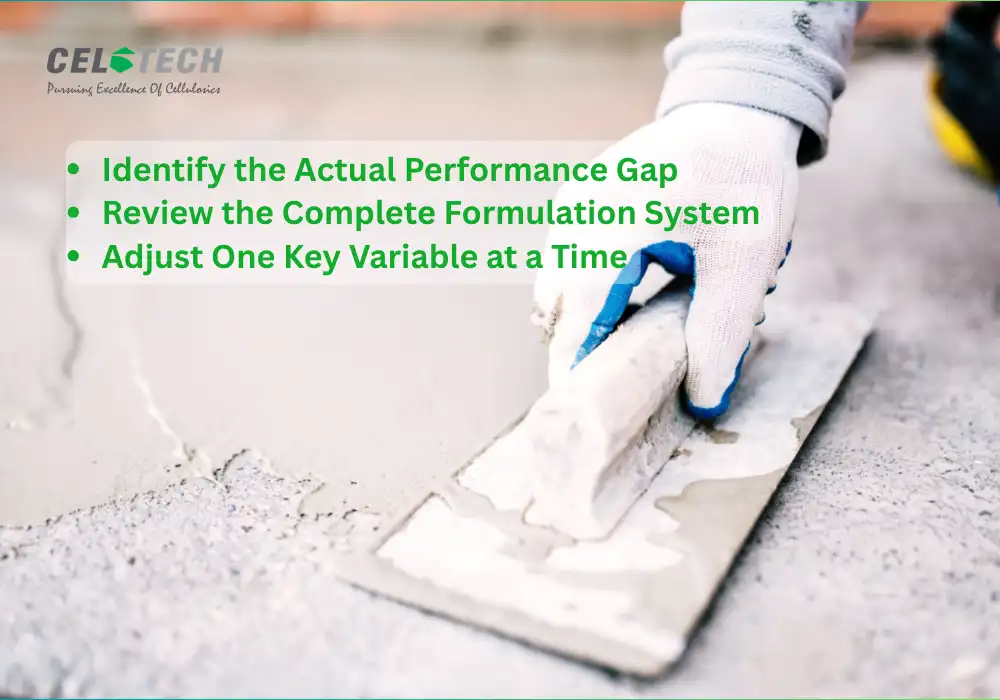
Step 1: Identify the Actual Performance Gap
Before making changes, define the problem clearly. You can take last paragraph as your problem directions.
Step 2: Review the Complete Formulation System
A wall putty formula should be evaluated as a complete system. Many formulation problems are caused by interactions between multiple factors. You should review:
| Area | Questions to Ask |
| Binder System | Is the strength level suitable for the application? |
| Filler System | Does particle size and content support the target finish? |
| Cellulose Ether | Does it provide suitable water retention and workability? |
| Polymer Additives | Is flexibility and adhesion sufficient? |
| Production Process | Are all components evenly dispersed? |
Step 3: Adjust One Key Variable at a Time
You’d better not change several components such as cement ratio, filler ratio, cellulose ether dosage, RDP dosage at a same time, it is difficult to understand which factor created improvement. A better approach is:
- Identify the weak performance area.
- Select one adjustment direction.
- Test laboratory samples.
- Compare results.
- Confirm improvement before scaling production.
This method gives you clearer formulation knowledge and reduces unnecessary trial costs.
11. How Should You Evaluate a New Wall Putty Formulation?
The best formulation is not only one that performs well in the laboratory, but one that remains stable during real application.
You should do below test to evaluate formulation:
| Test Area | Purpose | What You Learn |
| Water Retention Test | Evaluate moisture control ability | Whether curing conditions are sufficient |
| Adhesion Strength Test | Measure bonding performance | Whether the system provides enough bonding |
| Workability Evaluation | Check application experience | Whether users can apply it easily |
| Crack Resistance Test | Evaluate stress resistance | Whether the formulation can handle shrinkage |
| Surface Quality Inspection | Check final appearance | Whether the finish meets customer expectations |
12. How Can You Reduce Wall Putty Formulation Cost Without Sacrificing Quality?
Reducing cost only by lowering additive dosage can negatively affect product performance. the best strategy is to achieve the best cost-to-performance ratio that improve formulation efficiency.
| Cost Optimization Approach | Why It Works |
| Select suitable additive grade | Avoid unnecessary performance margin |
| Optimize raw material ratio | Improve cost-performance balance |
| Reduce formulation over-design | Avoid excessive additive usage |
| Improve production consistency | Reduce rejected batches and complaints |
13. Why Can’t You Simply Copy Competitor’s Wall Putty Formula?
A successful formulation needs adaptation, not simple duplication. because formuations ingredients are varies from below factors:
| Variable | Why It Affects Performance |
| Cement Source | Different reactivity and strength development |
| Filler Properties | Different particle size and absorption |
| Climate Conditions | Different drying behavior |
| Production Equipment | Different mixing efficiency |
| Customer Application Habits | Different performance expectations |
14. How a Professional Additive Partner Supports Your Formulation
When you work with a supplier who understands formulation challenges, you can reduce trial-and-error during product development. A reliable technical partner should help you with:
| Support Area | Value for Your Development |
| Additive Selection Guidance | Helps you avoid unsuitable choices |
| Formulation Discussion | Improves development efficiency |
| Problem Diagnosis | Helps identify possible causes |
| Application Understanding | Connects laboratory results with customer needs |
| Technical Documentation | Supports internal evaluation and customer communication |
15. Wall Putty Manufacturing Process
During real production, your manufacturing process directly affects additive dispersion, batch consistency, application performance, customer experience. Even a technically optimized formula may show unstable performance if the production process is not properly controlled.
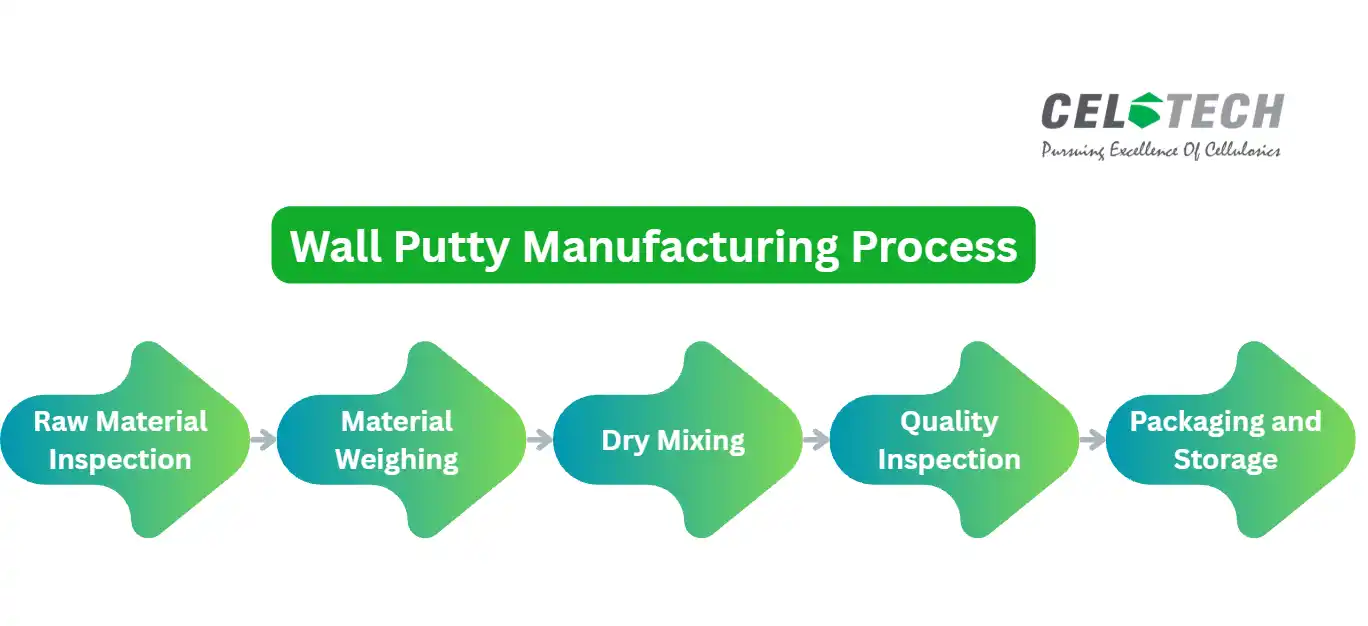
A typical dry-mix wall putty production process includes several key stages:
| Production Stage | What You Need to Control | Why It Matters |
| Raw Material Inspection | Moisture content, particle characteristics, material consistency | Prevents variation between batches |
| Material Weighing | Accurate ingredient ratio | Ensures formulation consistency |
| Dry Mixing | Uniform dispersion of all components | Prevents local concentration differences |
| Quality Inspection | Performance verification before shipment | Ensures product stability |
| Packaging and Storage | Moisture protection and handling conditions | Maintains product quality |
16. Quality Control Parameters for Wall Putty Manufacturing
Quality control should focus on understanding performance consistency, not only checking whether the final product passes inspection.
| Control Stage | Parameters to Evaluate | Purpose |
| Raw Materials | Moisture, particle size, quality consistency | Ensure stable input materials |
| Fresh Powder | Appearance, uniformity, bulk density | Confirm production stability |
| Mixed Product | Workability, consistency, water demand | Evaluate application behavior |
| Hardened Product | Adhesion, strength, crack resistance | Verify final performance |
| Field Application | Customer usage conditions | Confirm real-world performance |
17. How Celotech Supports Wall Putty Manufacturers
Developing reliable wall putty requires cooperation between formulation knowledge, additive technology, and production experience. Celotech provides cellulose ether and construction chemical additives designed for dry-mix manufacturers who need to improve: water retention, workability, adhesion, flexibility, formulation consistency.
Whether you are developing a new wall putty product or optimizing an existing formulation, selecting the right additive system is an important step toward achieving stable performance.
Frequently Asked Questions About Wall Putty Formulation
1. How do you know whether you should adjust your formulation or change your additive supplier?
Before changing suppliers, you should evaluate the complete system, raw materials, formulation design, production process, application conditions.
2. Can increasing HPMC dosage always improve wall putty performance?
No. Increasing HPMC may improve water retention, but excessive dosage can affect viscosity, mixing behavior, and application feel. The correct dosage depends on the complete formulation system.
3. How can you reduce wall putty production cost while maintaining performance?
Focus on formulation efficiency rather than simply reducing ingredient dosage. You can improve cost performance by optimizing raw material ratios, selecting suitable additive grades, reducing unnecessary formulation margin, improving production stability.
4. How long does it take to optimize a wall putty formulation?
The timeline depends on:current formulation condition, number of performance issues, testing requirements, production validation process. A systematic approach is usually faster than making multiple uncontrolled adjustments.
5. What information should you send to an additive supplier for technical support?
You should provide:current formula, target application, raw materials, current problems, expected improvement goals.
Conclusion
A successful wall putty formulation is not created by using more ingredients or copying another manufacturer’s formula.
It is created through a balanced approach, understanding application requirements, selecting suitable raw materials, designing the right additive system, controlling production consistency, validating performance through testing.
Celotech supports wall putty manufacturers with our Celopro® series and Vinabond® designed to help improve formulation stability and product performance.