Tartaric acid and commercial gypsum retarders differ significantly in their mechanism of action, performance impact, scope of application, and cost. Tartaric acid, as a general-purpose organic acid, has a direct but often problematic retarding mechanism, while commercial gypsum retarders are specialized, optimized products offering more balanced and reliable performance for gypsum systems.
Core Comparison About Tartaric Acid & Gypsum Retarder
| Comparison Dimension | Tartaric Acid | Commercial Gypsum Retarder (e.g., Gypstar® G300) |
| Mechanism & Nature | A general-purpose chemical raw material. It retards hydration primarily through chemical reaction (forming insoluble coatings on gypsum particles). Its action is direct but sensitive to system variables like pH. | A specialized, compounded product. Its mechanism is optimized, potentially combining adsorption, film-forming, etc., offering targeted efficiency for gypsum systems. |
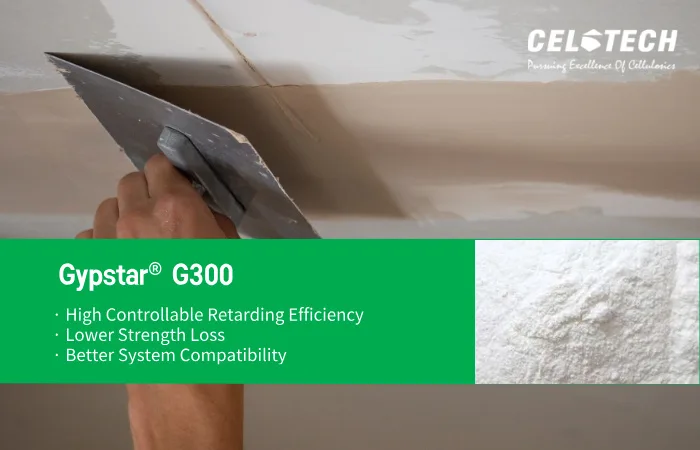
| Impact on Product Performance | Strong retarding effect: Can extend setting time by over 6 times even at low dosages (~0.1%). Reduces strength significantly: Alters crystal morphology from needle-like to short prismatic, leading to a looser structure. Typical compressive strength loss is 20%-30%. May improve fluidity: Can increase the 30-minute flow diameter in some gypsum self-leveling systems. | High and controllable retarding efficiency: Designed for gypsum, often offering higher efficiency per unit dosage and more precise control over setting time. Lower strength loss: Through formulation optimization, the negative impact on the strength of the hardened body is typically less than that of tartaric acid for equivalent retardation. Better system compatibility: Generally offers better adaptability and stable performance when combined with other gypsum additives (e.g., water reducers, water retention agents). |
| Primary Application Scenarios | 1. Basic research and low-cost formulation trials. 2. General plaster/putty products with low early-strength requirements but needing longer workability time. 3. Modifying industrial by-product gypsum (e.g., phosphogypsum) that sets too rapidly. Note: Effects can be unstable in complex binder systems (e.g., cement-gypsum composite). | 1.Commercial gypsum building products(e.g., gypsum boards, plastering gypsum, self-leveling gypsum) requiring high performance stability and workability. 2. Continuous, automated production lines needing precise setting time control for efficiency. 3. Mid-to-high-end gypsum-based plasters, putties, and special mortars. |
| Cost & Procurement | Relatively low raw material cost: A bulk chemical with transparent pricing and easy availability. Potentially higher comprehensive cost: Increased overall cost may result from higher dosage, strength loss requiring more binder, and risks from performance instability. | Higher purchase price: Includes added value from R&D, compounding, and technical service. Potentially lower comprehensive cost: High efficiency and performance optimization can reduce total dosage and lower overall cost by improving product qualification rate and stability. |
Key Additional Information You Should Notice
Limitations of Tartaric Acid: Beyond strength loss, tartaric acid is not always effective. Research indicates it may show no significant retarding effect in certain complex ternary systems composed of Portland cement, sulfoaluminate cement, and desulfurization gypsum.
Advantages of Commercial Retarders: Besides retardation, high-quality commercial retarders are often formulated considering synergistic effects with other components like water reducers and retention agents, better ensuring the overall performance of the final product.
Conclusions for Choosing Right One
The choice depends fundamentally on your specific needs:
Choose Tartaric Acid: Conducting preliminary formulation trials, producing very cost-sensitive low-end products with general performance requirements, or modifying specific industrial by-product gypsums.
Choose a Commercial Gypsum Retarder: Producing commercial products where performance stability and brand reputation are key (especially for lightweight plaster, putty, self-leveling), or for use in automated production lines.
Given the vast differences in gypsum types and specific formulations, it is essential to conduct small- and medium-scale tests with your actual raw materials before finalizing any formula. you can contact our expert for free sample.
If you can specify the type of gypsum you are using and the core performance requirements of your target product (e.g., required setting time range, strength class), Cemotech can provide a more tailored analysis.