What Is an Air-Entraining Agent?
Air-entraining agents are typically anionic surfactants used in cement-based materials.
Common types include:
- Rosin-based air-entraining agents
- Alkyl sulfonates such as SDS and AOS
These molecules contain:
- A hydrophilic group that attracts water
- A hydrophobic group that repels water
When concrete is mixed with water, AEAs reduce the surface tension of the mixing water, allowing air to be entrained during mixing.This process creates tiny, closed, and stable air bubbles, typically smaller than 200 μm, distributed throughout the mortar.These bubbles form a controlled air-void system that strongly influences both the fresh workability and hardened durability of concrete.
How Do Air-Entraining Agents Work in Concrete?
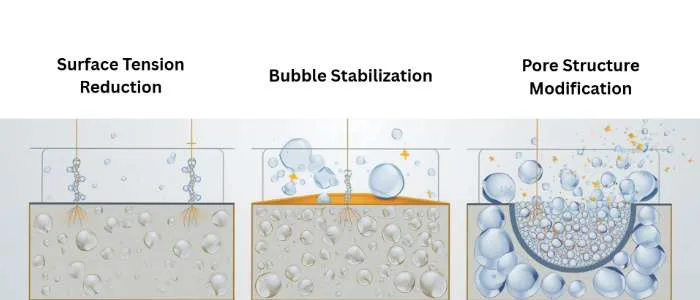
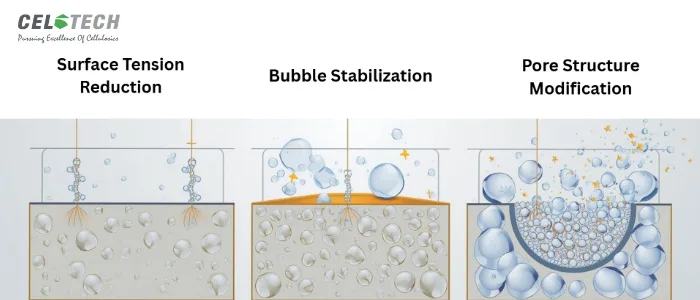
Air entrainment occurs through three primary mechanisms within mortar systems.
Surface Tension Reduction
Surfactant molecules accumulate at the air–water interface, lowering surface tension and allowing air bubbles to form more easily during mixing.
Bubble Stabilization
Each bubble is surrounded by a thin surfactant film that prevents bubble coalescence.
This stabilization allows micro-bubbles to survive mixing, pumping, and placement processes.
Pore Structure Modification
After hardening, these bubbles remain as closed air voids within the concrete matrix.
The air-void system interrupts capillary pore networks, improving durability properties such as freeze-thaw resistance and impermeability.
Key Functions of Air-Entraining Agents in Concrete
Air-entraining agents act as microstructure regulators that improve both fresh and hardened concrete properties.
Improved Concrete Workability
The entrained micro-bubbles function like “ball bearings” between aggregate particles.
Benefits include:
- Smoother concrete consistency
- Improved pumpability and sprayability
- Easier troweling and spreading
This is particularly beneficial for concrete containing manufactured sand, which typically has rough particle shapes and higher stone powder content.
Improved Water Retention and Reduced Bleeding
Entrained air bubbles distribute water more uniformly within the concrete matrix.
This helps:
- Prevent rapid water absorption by substrates
- Reduce surface bleeding
- Support consistent cement hydration
Better water distribution contributes to more stable microstructure development during curing.
Improved Freeze-Thaw Resistance
One of the most important benefits of air entrainment is improved freeze-thaw durability.
When water freezes and expands within the concrete pores, the entrained air bubbles act as expansion chambers, relieving internal pressure.
This prevents cracking, scaling, and spalling in cold-climate environments.
Improved Impermeability
The closed air bubbles interrupt capillary channels within the hardened concrete.
This reduces:
- Water penetration
- Harmful ion transport
- Corrosion risk
As a result, the durability of cement-based building materials is significantly improved.
Density and Shrinkage Regulation
Air entrainment slightly reduces mortar density.
This provides:
- Higher material coverage
- Improved economic efficiency
- Reduced drying shrinkage
However, excessive air content can negatively affect mechanical strength.
Uses of Air-Entraining Agents in Concrete
| Application Area | Primary Function | Technical Points & Effects |
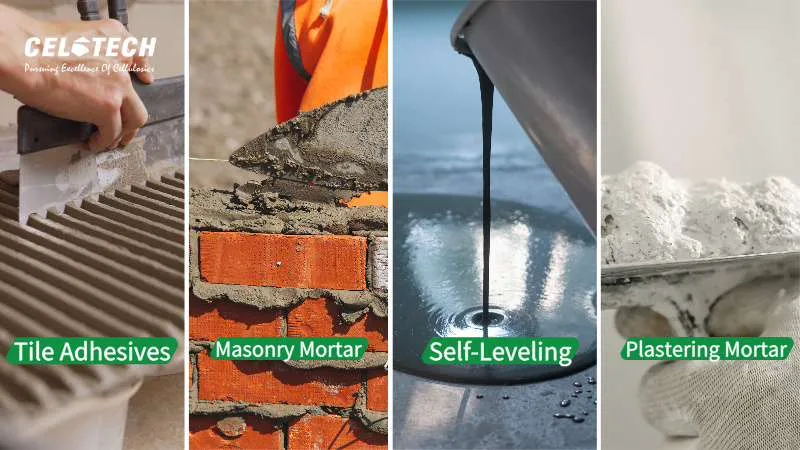
| Plastering Mortar & Sprayed Mortar | Enhancing pumpability and spray ability | Micro-bubbles improve lubricity, reduce pumping resistance, and minimize blockages. They also increase paste thixotropy, preventing sagging after application. Dosage must be controlled to avoid excessive strength loss. |
| Masonry Mortar | Improving joint filling, reducing water absorption | AEAs improve mortar spreadability, allowing for even bedding of blocks and higher joint fullness. Bubbles block capillary pores, reducing water absorption of the masonry and improving stability.
|
| Self-Leveling | Reducing shrinkage, preventing cracks | Effectively improves the drying shrinkage behavior of floor mortars, reducing the risk of hollowing and cracking. |
| Thermal | Lowering thermal conductivity | Insulation MortarLeveraging the low thermal conductivity of air, the numerous closed pores significantly enhance the insulation performance of the mortar. |
| Waterproofing Concrete | Increasing impermeability | By interrupting capillary pores,AEAs substantially increase the mortar’s resistance to water penetration pressure, enhancing waterproofing effectiveness. |
| Tile Adhesives & Grouts | Improving anti-slip properties | Appropriate air bubbles can increase the paste’s thixotropy, preventing tiles from slipping during installation and making grouting applications smoother. |
Compatibility with Other Concrete Additives
In modern concrete formulations, air-entraining agents are typically used together with other functional additives.
These additives may include:
- Hydroxypropyl Methylcellulose
- Hydroxyethyl Methyl Cellulose
- Redispersible Polymer Powder
- Cellulose Fiber
Cellulose ethers regulate water retention and rheology, while polymer powders improve adhesion and flexibility. Together with air-entraining agents, they form a balanced additive system for optimizing mortar performance.
Recommended Dosage of Air-Entraining Agents in Concrete
| Mortar Type | Typical AEA Dosage |
|---|---|
| Plastering mortar | 0.002–0.005% |
| Masonry mortar | 0.003–0.008% |
| Insulation mortar | 0.005–0.01% |
Excessive dosage may lead to:
Reduced compressive strength
Reduced bond strength
Therefore, precise dosage control is essential.
Key Considerations When Using Air-Entraining Agents
Raw Material Sensitivity
Raw materials such as manufactured sand and fly ash can affect AEA performance.
High stone powder content may adsorb surfactants and reduce air entrainment efficiency.
Compatibility with Other Additives
Some mortar additives may influence the air-entraining efficiency.
Laboratory testing is recommended to determine the optimal additive combination.
Conclusion
Air-entraining agents are important dry-mix concrete additives that regulate cement microstructure and construction performance.
By introducing stable microscopic air bubbles, they improve:
- Concrete workability
- Freeze-thaw durability
- Impermeability
- Shrinkage control
When properly balanced with cellulose ethers, polymer powders, and other functional additives, air-entraining agents help formulators develop high-performance dry-mix mortar systems.