Industrial Guide for Cement Mortar & Concrete Repair Systems
Cement cracks are not only a surface defect—they are usually a symptom of shrinkage stress, moisture imbalance, substrate movement, or improper curing in cement-based systems.
In real construction environments such as tile adhesive applications, plastering, skim coat, and repair mortar systems, crack repair is not simply about filling concrete gaps. We have observed that more than 60% of recurring cracks are linked to insufficient material system selection rather than application itself.
In our practical on-site projects, many cracks will begin to appear during the early curing stage, especially under hot, windy, or highly absorbent substrate conditions where moisture evaporates faster than cement hydration can properly develop.
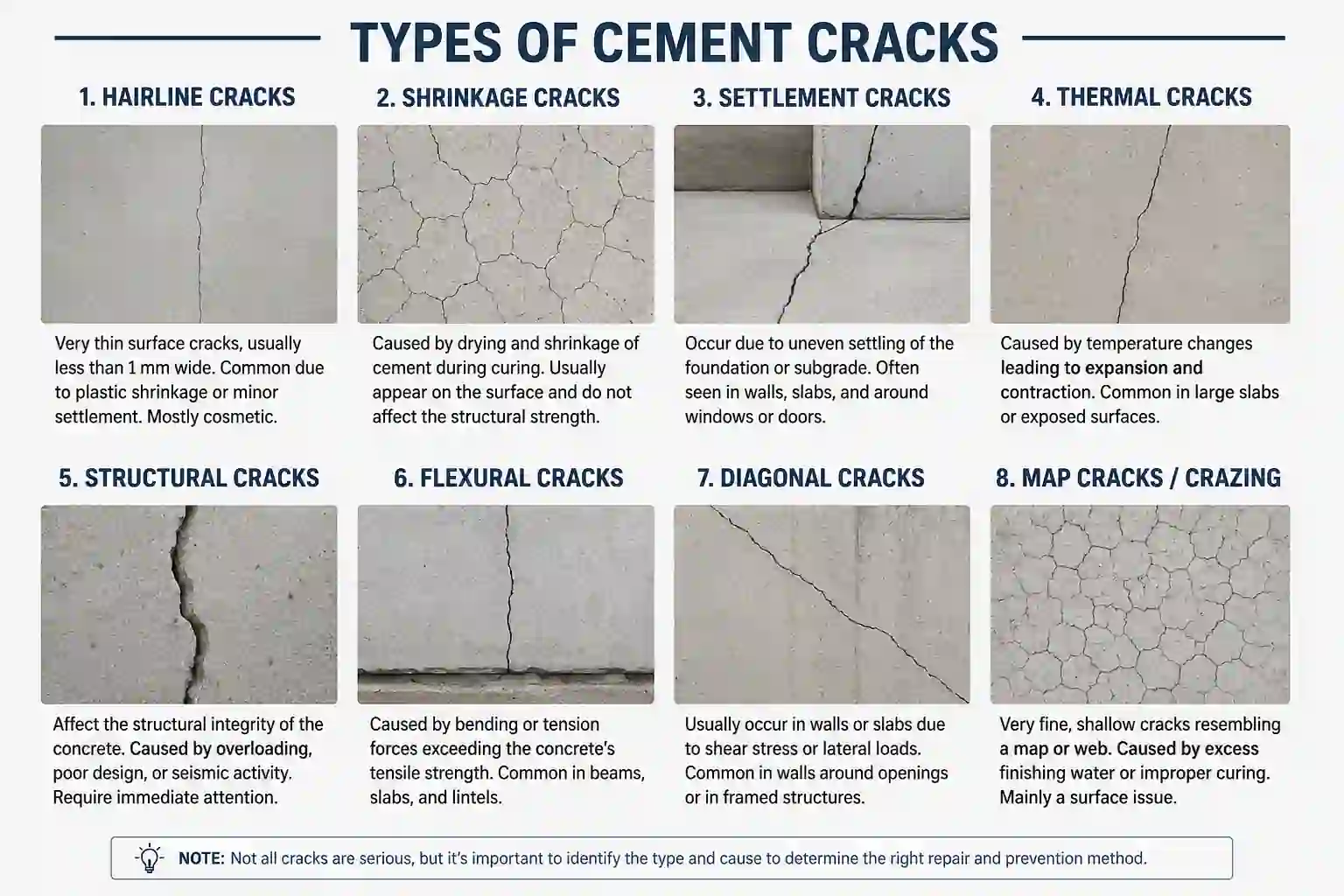
1. Identify the Type of Cement Cracks Before Repair
Different cracks require different repair strategies.
1.1 Hairline Shrinkage Cracks
In field applications, hairline cracks are often misjudged as structural cracks, leading to over-repair and material waste. To clarify its characteristics:
- Very fine surface cracks
- Usually appear within the first 24–72 hours
- Common in plaster, skim coat, and thin-layer mortar systems
These cracks are often related to: rapid surface drying, excessive water evaporation, insufficient curing or high substrate absorption.
Summary from our on-site cases, hairline cracks are not structural failures but moisture-related shrinkage stress.
1.2 Structural Cracks
Structural cracks with characteristics as below:
- Wider and deeper cracks
- May continue expanding over time
- Often related to substrate movement or loading stress
Structural cracks usually require reinforcement or injection repair methods rather than simple surface patching.
1.3 Thermal or Curing Cracks
These cracks are commonly found in: large concrete surfaces, thick repair sections, high-temperature construction environments.
Rapid hydration heat combined with uneven moisture loss can create internal stress differences inside cementitious systems.
2. Surface Preparation Before Repair
Before you start to repair cement cracks, some jobs should be done carefully:
- Remove surface dust and loose particles
- Eliminate weak layers and laitance
- Clean oil contamination
- Slightly widen narrow cracks if necessary
- Pre-wet highly absorbent substrates
Surface preparation is underestimated in repair projects often. From our on-site experiments, repair failure is incorrectly blamed on mortar quality, while the real issue comes from poor substrate preparation or uneven moisture absorption at the interface layer.
Highly absorbent substrates such as AAC blocks or dry concrete surfaces can rapidly pull water from fresh repair mortar, interrupting normal cement hydration near the bonding interface.
3. Repair Methods Based on Crack Severity
3.1 Fine Surface Cracks
For hairline shrinkage cracks, polymer-modified cementitious repair mortar is commonly used, characteristics:
- Fine particle grading
- Good water retention
- Low shrinkage tendency
- Strong bonding performance
Typical you can follow below steps repair process:
- Clean the crack area
- Apply repair mortar evenly
- Compact and smooth the surface
- Maintain proper curing conditions
In fast-drying local conditions, repair layers may lose moisture too quickly during the first 2-3 hours, which significantly increases the risk of secondary microcracking.
3.2 Medium Cracks
Medium concrete cracks usually require: deeper filling, improved flexibility, and stronger interface bonding.
Cracks wider than approximately 2–3mm often need repair systems with better deformation tolerance.
Typically, repair mortar systems may include:
- Cement
- Graded aggregates
- Redispersible polymer powder (RDP)
- Cellulose ether (HPMC / MHEC)
The combination of polymer flexibility and stable water retention is critical for reducing internal shrinkage stress after repair.
3.3 Structural Cracks
For active or structural cracks: injection repair systems, reinforcement treatment, or structural evaluation
may be necessary. Simple concrete cracks sealing is usually insufficient for moving substrates.
4. Why Repaired Cement Cracks Often Reappear
Many repair projects fail not because repair strength is too low, but because moisture migration behavior inside the system was not properly controlled.
Common reasons include: rapid surface drying, insufficient curing, differential shrinkage between old and new mortar, weak substrate bonding, or excessive water addition on-site.
One common on-site mistake is adding excessive water to improve workability. Although the mortar becomes easier to apply, higher water demand usually creates larger pore structures after drying, leading to greater shrinkage and crack sensitivity.
5. Key Material Mechanisms in Crack Repair Systems
5.1 Water Retention Control
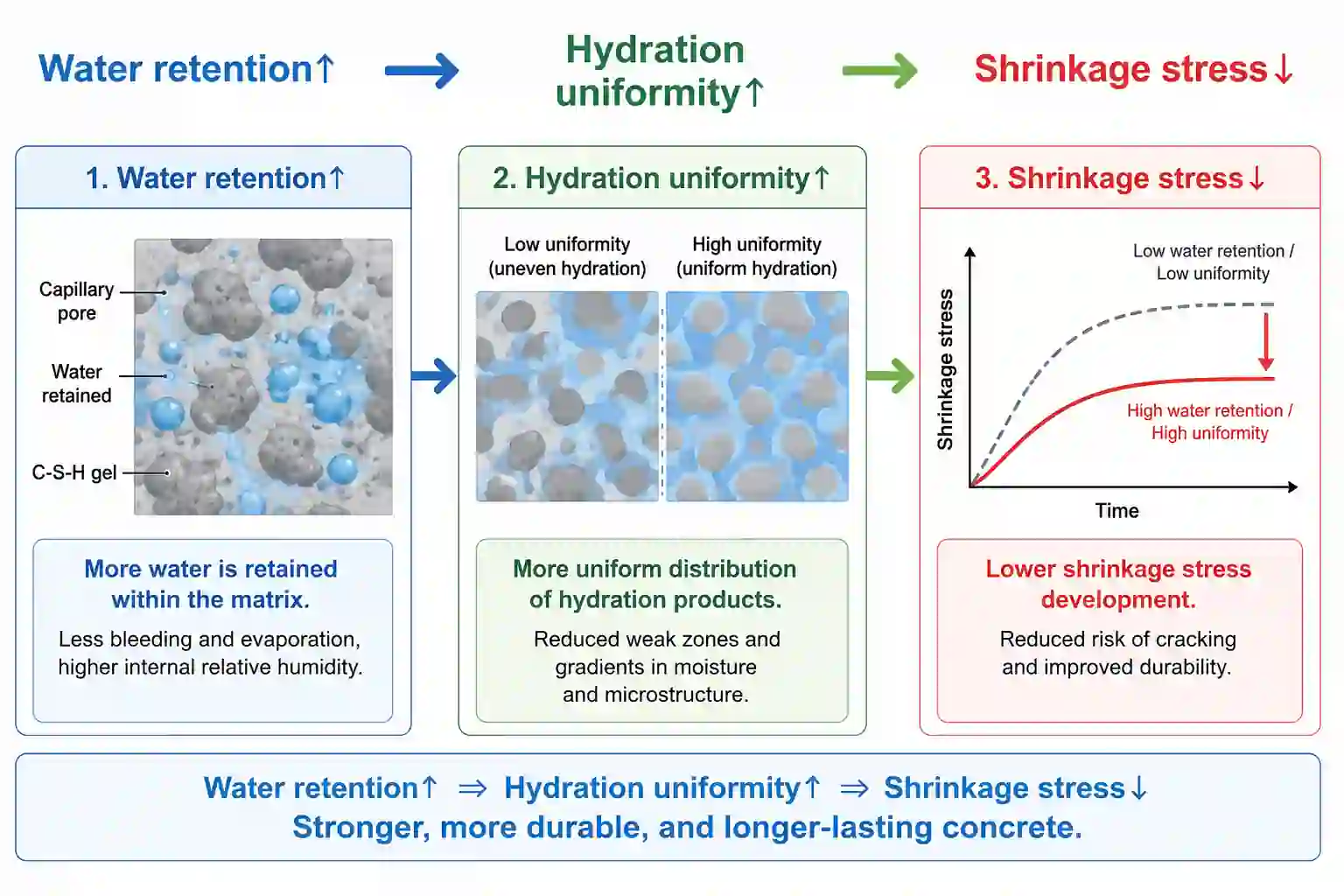
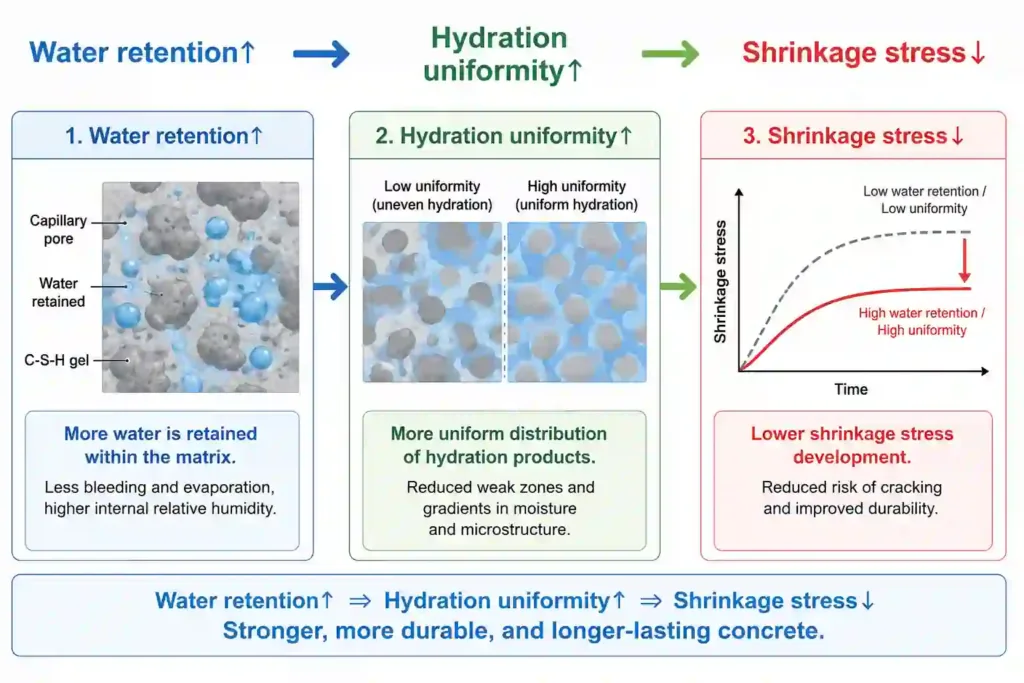
Water retention↑⇒hydration uniformity↑⇒shrinkage stress↓
Stable water retention helps: maintain concrete hydration, reduce rapid moisture loss, improve bonding stability. In highly absorbent substrates, insufficient water retention may cause localized hydration interruption, resulting in secondary surface cracking after repair.
Cellulose ether (HPMC / MHEC) is commonly used to stabilize water distribution during curing.
5.2 Shrinkage Stress Development
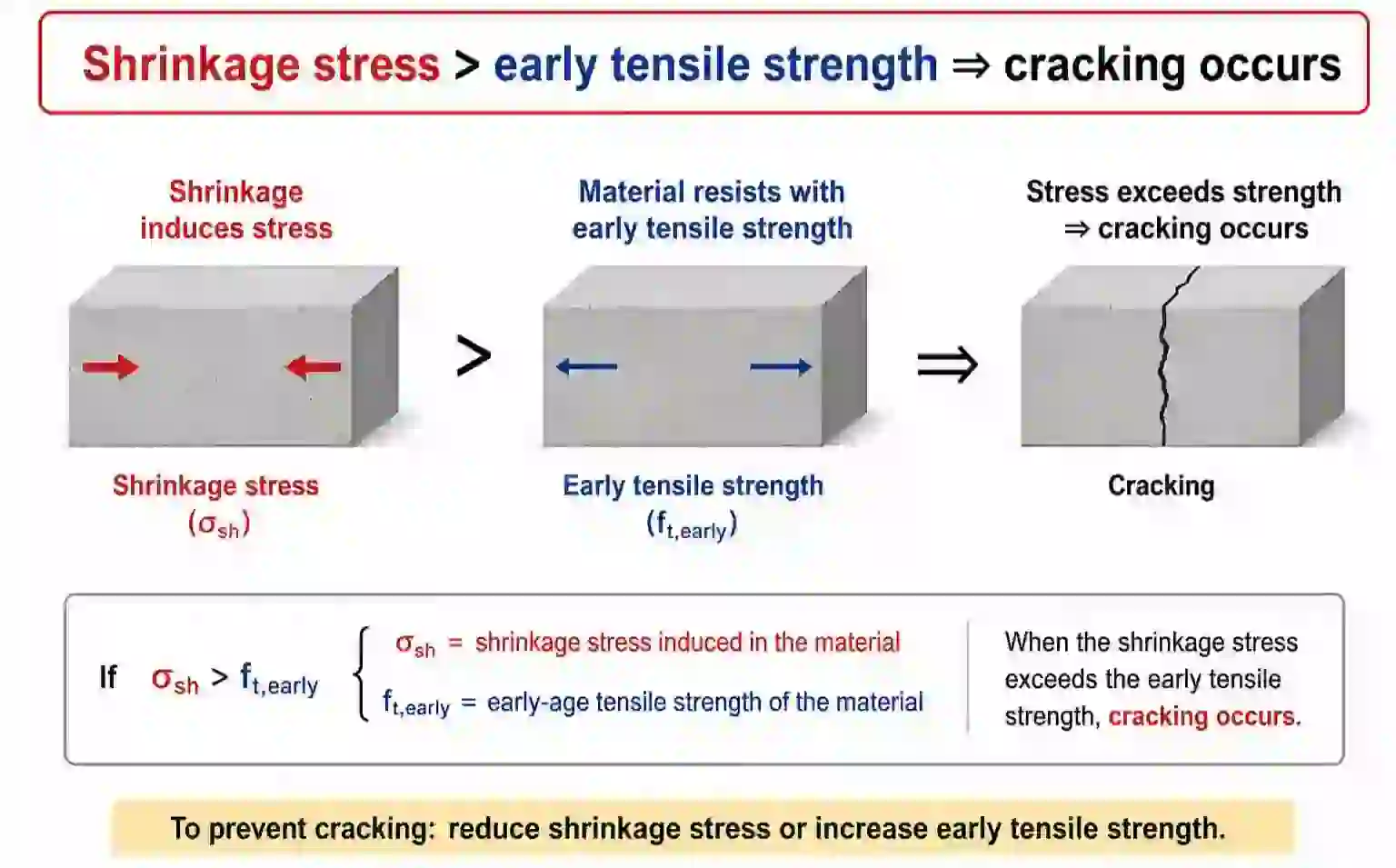 Shrinkage stress>early tensile strength⇒cracking occurs
Cracking occurs when internal shrinkage stress exceeds the early tensile strength of the repair layer. Factors influencing shrinkage stress include: evaporation rate, substrate absorption, curing temperature, water demand, layer thickness.
5.3 Flexibility Improvement
Redispersible polymer powder (RDP) improves: flexibility, adhesion, deformation tolerance, crack resistance under substrate movement.
Polymer modification becomes especially important in systems exposed to vibration, thermal cycling, or substrate deformation.
6. Recommended Additive System for Crack-Resistant Repair Mortar
A stable cement crack repair system often includes:
| Component | Main Function |
| HPMC / MHEC | Water retention & workability |
| RDP | Flexibility & adhesion |
| Fine graded fillers | Dimensional stability |
| Defoamer | Air void reduction |
| Fiber reinforcement | Crack resistance improvement |
For repair mortars exposed to rapid drying environments, cellulose ether selection becomes particularly important during the early curing stage.
According to our lab testing and real on-site experience, crack resistance is not determined by one additive alone, but by the balance between: water retention, hydration rate, flexibility, substrate compatibility, and shrinkage control.
7. Proper Curing After Repair
Curing is one of the most critical stages in concrete crack repair. You should pay attention on avoiding direct sunlight, reducing wind exposure, maintaining moderate moisture conditions, and avoiding premature drying.
According to our clients saying and many practical projects, crack recurrence is caused more by improper curing control than by insufficient repair material strength.
8. When Material Upgrade Is Better Than Repeated Repair
Repeated cracking often indicates that the original mortar system lacks: sufficient flexibility, stable water retention, or compatibility with substrate movement.
In these kind situations, repeatedly patching cracks without improving the material system usually provides only temporary results. Polymer-modified repair systems with optimized cellulose ether and RDP balance provide more reliable long-term performance generally.
9. Industrial Perspective on Cement Crack Repair
From an application engineering perspective, cement crack repair performance is rarely controlled by one single factor as we mentioned before, Successful repair systems usually depend on the balance between: moisture control, hydration stability, flexibility, shrinkage management,and substrate interaction.
As we all know that drymix mortar system optimized additive combinations are increasingly important for maintaining crack resistance under different climate and construction conditions.