Personal Care Cosmetic Ingredients

Cosmetic Ingredients Supplier

Modern personal care formulations are becoming increasingly complex due to multi-component surfactant systems, electrolyte presence, and performance-demanding textures.

Celotech functional polymers are designed to support formulation stability and performance optimization in these systems by providing:

  • Controlled rheology and viscosity build-up in aqueous and surfactant systems
  • Improved emulsion stability in cream and lotion systems where phase separation may occur
  • Enhanced sensory performance and spreadability in leave-on and rinse-off products
  • Stable conditioning and deposition performance in hair care systems
  • Compatibility with electrolytes, surfactants, and alcohol-based formulations

These functions are achieved through carefully engineered cellulose derivatives and cationic conditioning polymers.


Cosmetic Ingredients Supplier

Personal Care & Cosmetic Formulation Solution

Celotech personal care Formulation Solutions

Celotech provides functional personal care & cosmetic additive formulation solutions for 15 Years, focusing on viscosity control, emulsion stability, and conditioning performance in modern cosmetic systems.

Our solutions support:

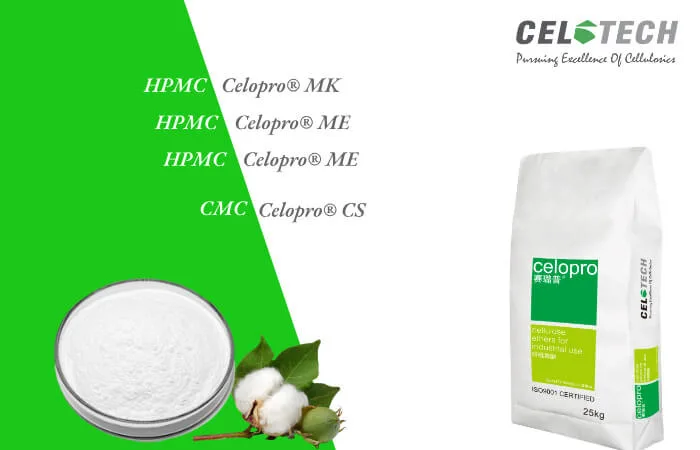
  • Celopre® ME Series offers rheology and viscosity modification
  • Celopre® MK Emulsion stability improvement
  • Celopre® MF Hair conditioning and deposition enhancement
  • HPMC and HEC all can offer compatibility with surfactant and electrolyte systems

Our Suggested Additives Formulation

Each solution is supported by tailored additive grades optimized for specific formulation systems.

Application Formulation Need Recommended Product Function Problem Solved
Shampoo / Cleanser Viscosity control in surfactant system Celopre® H Series HEC Thickener / Rheology modifier Prevents low viscosity and instability in surfactant systems
Shampoo / Conditioner Hair conditioning & smoothness Celopre® Cationic Guar Conditioning polymer Reduces tangling, improves combability
Cream / Lotion Emulsion stability Celopre® ME Series Film former / stabilizer Prevents phase separation in emulsions
Cleanser / Body Wash Foam stability Celopre® HEC Series Foam stabilizer Improves foam persistence and texture
Alcohol-based systems Thickening & stability Celopre® Modified Grades Thickener Maintains viscosity in ethanol systems


Why Choose Celotech Solution?

Cosmetic Ingredients Key advantages

Celotech functional additive solutions are designed to deliver reliable and consistent performance:

  • Reliable formulation stability:Consistent viscosity and performance across complex surfactant and emulsion systems
  • Broad system compatibility:Suitable for a wide range of formulations including aqueous, surfactant, and alcohol-based systems
  • High efficiency at optimized dosage:Achieve desired performance with lower usage levels, improving cost efficiency
  • Enhanced sensory performance:Improved texture, foam quality, and conditioning effect in finished products
  • Formulation-focused technical support:Assistance in optimizing formulation performance and selecting the right polymer grades

Application Areas

Our functional additives are widely used across a range of personal care and cosmetic formulations:

  • Shampoo & Conditioner:For viscosity control, foam stability, and conditioning performance
  • Body Wash & Facial Cleansers:For mild thickening and stable surfactant systems
  • Creams & Lotions:For emulsion stability, texture optimization, and film-forming performance
  • Serums & Gel Systems:For smooth rheology and improved spreadability
  • Alcohol-Based Formulations:For stable viscosity in ethanol-containing cosmetic systems

Recommended Products

Our Service

Technical support

Cosmetic and personal care systems provides excellent parameters in lab and on-site applications:

  • Excellent compatibility with anionic, nonionic, and amphoteric surfactants
  • Stable viscosity performance under electrolyte and salt conditions
  • Wide pH stability range for diverse formulation systems
  • Effective at low usage levels with consistent performance
  • Suitable for both rinse-off and leave-on applications
  • Improved sensory profile in final consumer products

Practical Support for Personal Care Formulations

Celotech supports formulation optimization across a wide range of personal care and cosmetic systems.

  • Polymer grade selection
    Based on formulation type, surfactant system, and compatibility requirements
  • Viscosity and texture optimization
    Adjust rheology performance for shampoo, cleanser, and emulsion systems
  • Stability troubleshooting
    Resolve issues such as phase separation, viscosity loss, and foam instability
engineers support
Sample Support

Technical Service & Sample Support

We provide practical technical services to support your product development process.

Services include:

  • Sample supply for lab-scale formulation testing
  • Pilot formulation evaluation support
  • Technical datasheets and documentation
  • Ongoing technical communication during development

Related Posts

Based on the 2026 hydroxyethyl cellulose(HEC) market, key selection criteria, global manufacturer comparisons, and geopolitical tensions, choose a suitable HEC manufacturer.
HPMC and CMC have differences in properties and performances. The condition of choosing the right one is to see which is suitable for your production or project needs. In summary, HPMC provides high-performance and is more widely used in many applications, while CMC is more cost-effective and suits low requirements and cost control projects.
Uncover the synergistic power of starch Ether & cellulose cther in wall putty. Learn how Celotech’s Celopro® and Stargel® optimize workability, anti-sag, & durability for superior, cost-effective wall finishes. Expert guide + product recommendations inside.

Frequently Asked Questions

Salt can affect the structure of surfactant systems, leading to viscosity changes. Proper selection of thickening additives can help maintain stable rheology.

Phase separation can be reduced by optimizing the emulsifier system and improving the overall formulation structure. Using suitable rheology modifiers such as cellulose derivatives (e.g., HPMC or HEC) helps stabilize the continuous phase, while proper mixing and ingredient compatibility also play important roles.
HEC is typically used for viscosity control in surfactant systems, while HPMC is more commonly applied in film-forming and emulsion stabilization.
Foam stability can be enhanced by optimizing additives systems that support foam structure and reduce collapse during use.

Next Application

We value your privacy

We use cookies to enhance your browsing experience, serve personalised ads or content, and analyse our traffic. By clicking "Accept All", you consent to our use of cookies.

Get a Quote