In mortar formulation design, “waterproofing” and “moisture resistance” are two easily confused but fundamentally different requirements. Many engineers, when faced with customer complaints such as wall water seepage, discolored grout, or efflorescence on finishing layers, instinctively increase the dosage of polymer powder. That result in cost soaring while performance remains unsatisfactory.
Common Misunderstanding in Waterproof Mortar
- Mistake 1: Only increasing RDP dosage to solve water seepage
- Mistake 2: Using polymer powder in breathable systems (ETICS)
- Mistake 3: Confusing water repellency vs waterproofing (core confusion)
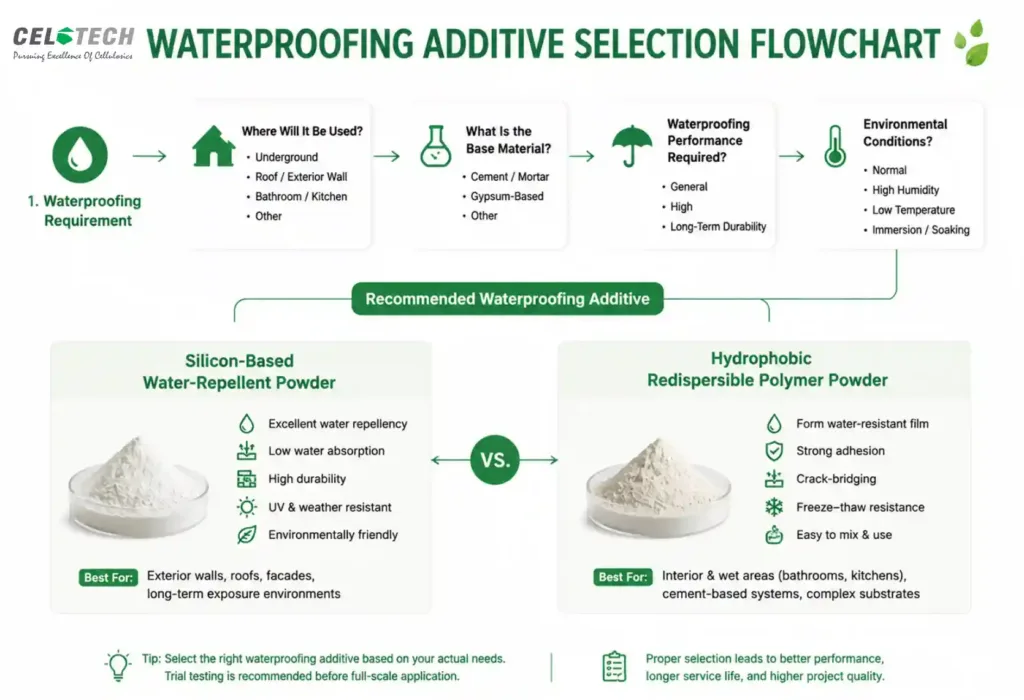
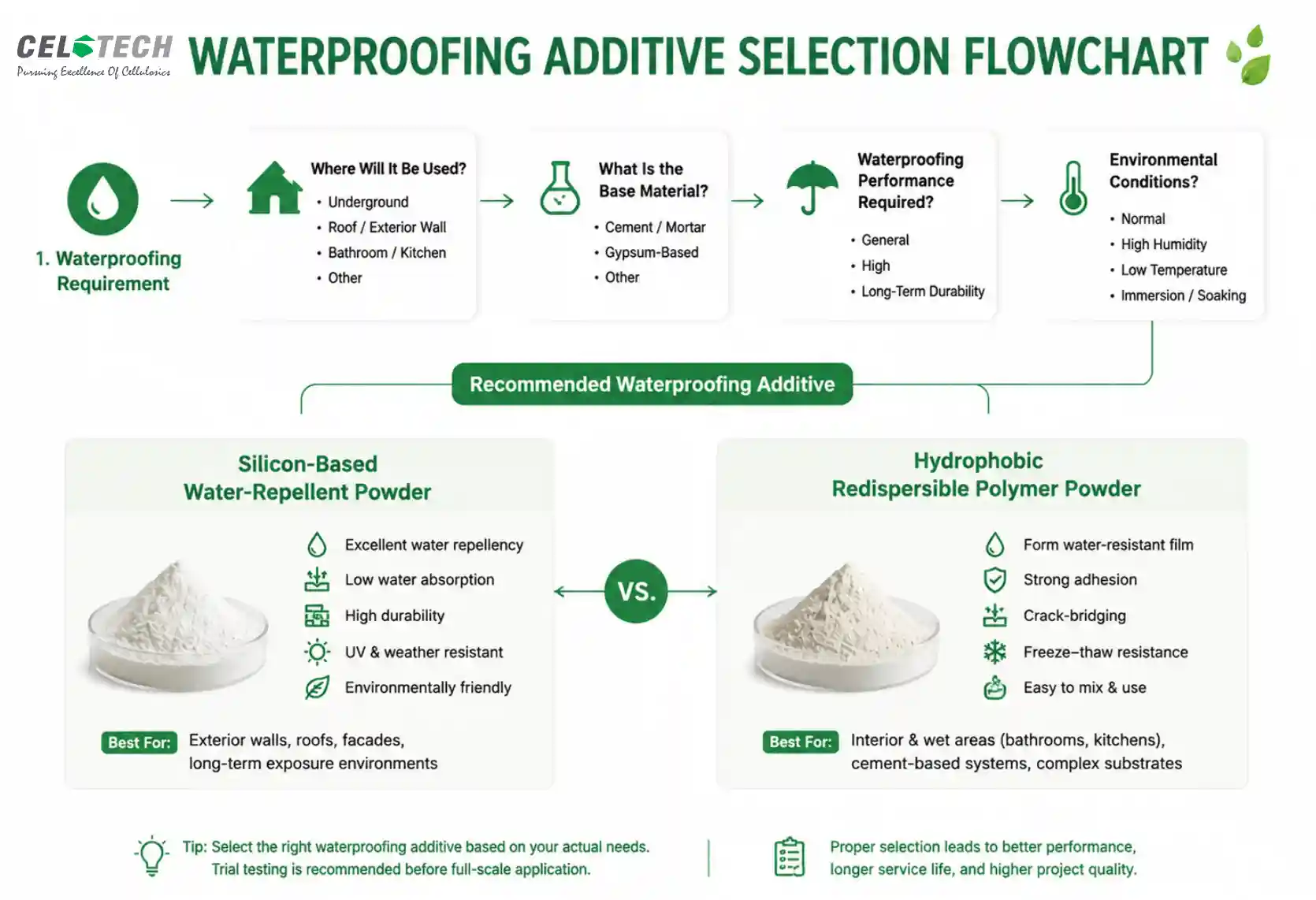
Currently, silicon-based water-repellent powder and hydrophobic redispersible polymer powder are the two main additives on the market that are providing water resistance in construction field. But their working mechanisms, performance focuses, and application scenarios are different significantly.
Mechanism Comparison: Surface Tension vs. Film Formation
Silicon-Based Water-Repellent Powder – Lowering Surface Energy, Making Water “Unable to Stand”
Silicon-based water-repellent powders (e.g., Aquago WP260,Aquago WP200H) contain active ingredients such as organosilanes or siloxanes. When mixed with water in mortar, they undergo hydrolysis and polycondensation, chemically bonding with hydroxyl groups on cement hydration products and aggregate surfaces. This forms a ‘nanoscale hydrophobic silicone network’ on capillary walls and particle surfaces.
Key characteristics:
- Excellent vapor permeability:pores are not blocked; water vapor can pass freely (walls can “breathe”).
- Surface water repellenc: prevents liquid water ingress but does not block water vapor.
- Typical effect: Water beads up and rolls off the surface; the wall repels water but remains breathable.
Hydrophobic Additives for Cement RDP – Film-Forming and Sealing, Blocking Water Pathways
Hydrophobic redispersible polymer powders (e.g., Vinabond H518, Vinabond H878) are produced by introducing silicon-based functional monomers into conventional polymer powders or spray-drying special hydrophobic polymer emulsions. When mixed with water in mortar, they redisperse into an emulsion. After water evaporates, they form a continuous polymer film.
Key characteristics:
- Low vapor permeability: the continuous polymer film significantly reduces water vapor transmission.
- Physical barrier: blocks both liquid water and water vapor.
- Additional benefits: provides significant adhesion, flexibility, and cohesive strength.
Quick Comparison
| Aspect | Silicon-Based Water-Repellent Powder (Aquago WP260/WP200H) | Hydrophobic Polymer Powder (Vinabond H518/H878) |
| Mechanism | Chemical bonding, alters surface polarity of capillary walls | Physical film formation, fills and seals capillaries |
| Water resistance effect | Surface hydrophobicity (lotus effect), blocks liquid water | Bulk waterproofing, blocks both liquid water and vapor |
| Vapor permeability | Excellent (wall breathes, no blistering) | Poor (may hinder moisture diffusion) |
| Bond strength | Minimal contribution | Significantly improved (strong adhesion to various substrates) |
| Flexibility/crack resistance | No contribution | Greatly improved (resists dynamic cracking) |
| Water pressure resistance | Low (not suitable for prolonged immersion or positive/negative pressure) | High (continuous film withstands water pressure) |
| Typical dosage | 0.1% – 0.5% (of dry mix) | 1% – 3% (of dry mix) |
How to Choose Waterproofing Mortar Additives?
Scenario 1:ETICS Waterproofing Solution-Base Coat
- Requirement: Prevent rainwater penetration while ensuring water vapor can diffuse outward from the wall (vapor permeability) to avoid condensation and freeze-thaw damage inside the insulation layer.
- Recommendation: Aquago WP200H, Extremely strong hydrophobicity – lower dosage achieves high water beading effect. Ideal for high-end decorative mortars or self-cleaning wall surfaces requiring very high contact angles.
Scenario 2: Tile Grout Waterproofing Additives
- Requirement: Mold resistance, anti-staining, easy cleaning. Prevents water from entering joints while allowing the wall/floor to “breathe” to avoid moisture accumulation.
- Options: Silicon-based powder only: Good surface hydrophobicity, but grout may lack cohesion and abrasion resistance.
- Hydrophobic polymer powder only: Strong waterproofing but may be too dense and costly.
- Recommended approach: Small amount of silicon-based powder + conventional polymer powder, or a dedicated hydrophobic polymer powder. Vinabond H518: Silicon-modified hydrophobic polymer powder. Balances adhesion of polymer powder with surface hydrophobicity of silicones. Ideal for high-end colored grouts – solves adhesion, flexibility, and hydrophobicity with a single addition.
Scenario 3: Rigid Waterproofing Mortar / Kitchen & Bathroom Waterproofing
- Requirement: Withstand some water pressure (e.g., standing water, bathroom tanks), extremely low water absorption, and long-term water immersion resistance. Vapor permeability is less critical.
- Recommendation: Vinabond H878 – Styrene-acrylic hydrophobic polymer powder. The styrene-acrylic system offers excellent water resistance and alkali resistance. Combined with hydrophobic design, the film is highly dense. Especially suitable for single-component waterproof coatings, repair mortars, etc., where hydrostatic pressure is present.
How to Choose: Selection Logic
| Step | Key Question | If YES | If NO |
|---|---|---|---|
| Step 1 | Is vapor permeability required? | Use Silicon-based hydrophobic powder (breathable system, prevents moisture trapping) | Go to Step 2 |
| Step 2 | Is water pressure involved? | Use Hydrophobic RDP (film-forming system) (dense waterproof barrier) | Go to Step 3 |
| Step 3 | Is bonding strength a key requirement? | Use Hydrophobic RDP system (preferred) (improved adhesion + flexibility) | Use Siloxane-based surface hydrophobic system |
For customized cost analysis or performance optimization for your specific formulation, please contact our technical team. We offer one-on-one product selection guidance.
What Happens If You Choose Wrong?”
Case 1: Too much RDP in exterior wall
- Reduced breathability
- Blistering / hollowing
- Freeze-thaw damage risk
Case 2: Only silicon powder in waterproof coating
- Insufficient water pressure resistance
- Long-term leakage risk
Final Thoughts
From the application perspective, silicon-based water-repellent powder is priority to extrodinary waterproofing request, if you want multifunctional with high adhesion, flexibility, anti-crack and waterproofing, then Hydrophobic will be the best choice for your project. If there is more confusions about selection, feel free to consult our expert for specific analysis your application.
FAQ:
Q1: What is the difference between waterproofing and moisture resistance in mortar?
A: Waterproofing blocks liquid water penetration, while moisture resistance allows vapor diffusion and prevents damp-related damage.
Q2: What causes efflorescence in mortar?
A: It is mainly caused by water migration carrying soluble salts to the surface.
Q3: Can silane replace polymer powder?
A: No, they work through different mechanisms and are used for different performance requirements.