- What Is Polypropylene Fiber?
- What Is Steel Fiber?
- PP Fiber vs Steel Fiber: Key Differences
- PP Fiber vs Steel Fiber: Quick Comparison
- Are PP Fiber and Steel Fiber Direct Substitutes?
- How to Choose Between PP Fiber and Steel Fiber?
- Conclusion
- FAQ
Introduction
PP fiber and steel fiber are two main reinforcements for concrete. But these two concrete fibers focus on different challenges with different performance and functions. This article will analyze their distinctions in crack control, durability, applications, etc. Based on the quick guidance, you can understand how to choose and combine them.
What Is Polypropylene Fiber?
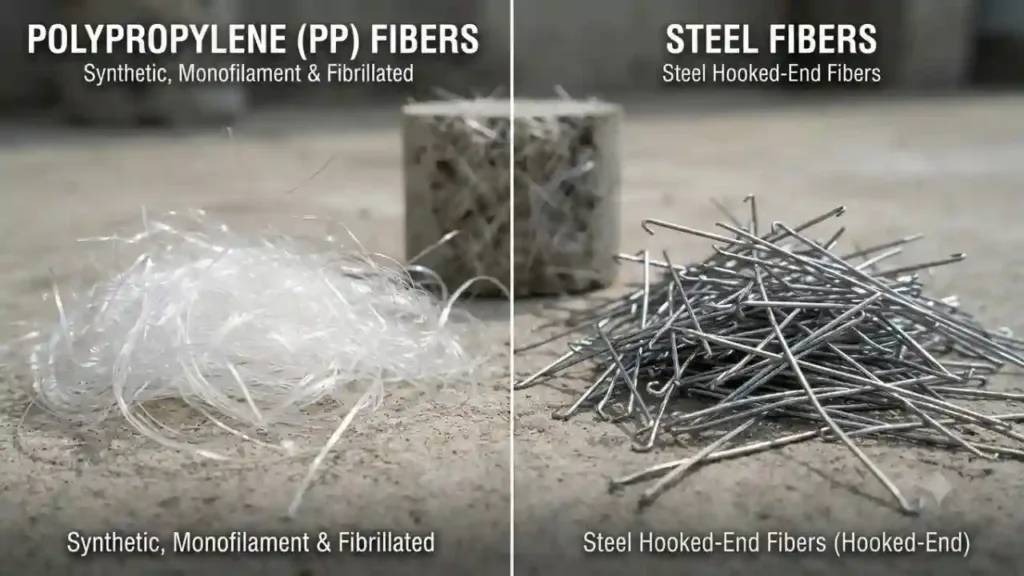
The full name of PP fiber is polypropylene fiber. As the name indicates, it is synthesized with polypropylene. You can find PP fiber widely used in concrete and mortar.
PP fiber is mainly used as a secondary reinforcement material. When you add it to the concrete or mortar, the fiber will be distributed throughout the mixture. Then it can control crack, improve internal stability, and durability.
Based on the structure and application requirements, we usually can divide the PP fibre into several types:
- Monofilament PP Fiber:Made of individual thin fibers and mainly used for controlling plastic shrinkage cracks in concrete and mortar.
- Fibrillated PP Fiber:A mesh-like fiber structure that provides better interaction with the cement matrix.
- Macro Synthetic PP Fiber:It is a type of larger fiber, which is designed for improved crack bridging and toughness.
What Is Steel Fiber?
Steel fiber is a metallic fiber, and is usually produced from steel. It is primarily used to improve the mechanical performance when added to concrete.
Steel fibers for concrete can meet higher reinforcement performance compared with PP fibers. It can improve crack bridging and stress transfer better than PP fiber.
Steel fiber reinforcement is more suitable for heavy-duty concrete applications.
PP Fiber vs Steel Fiber: Key Differences
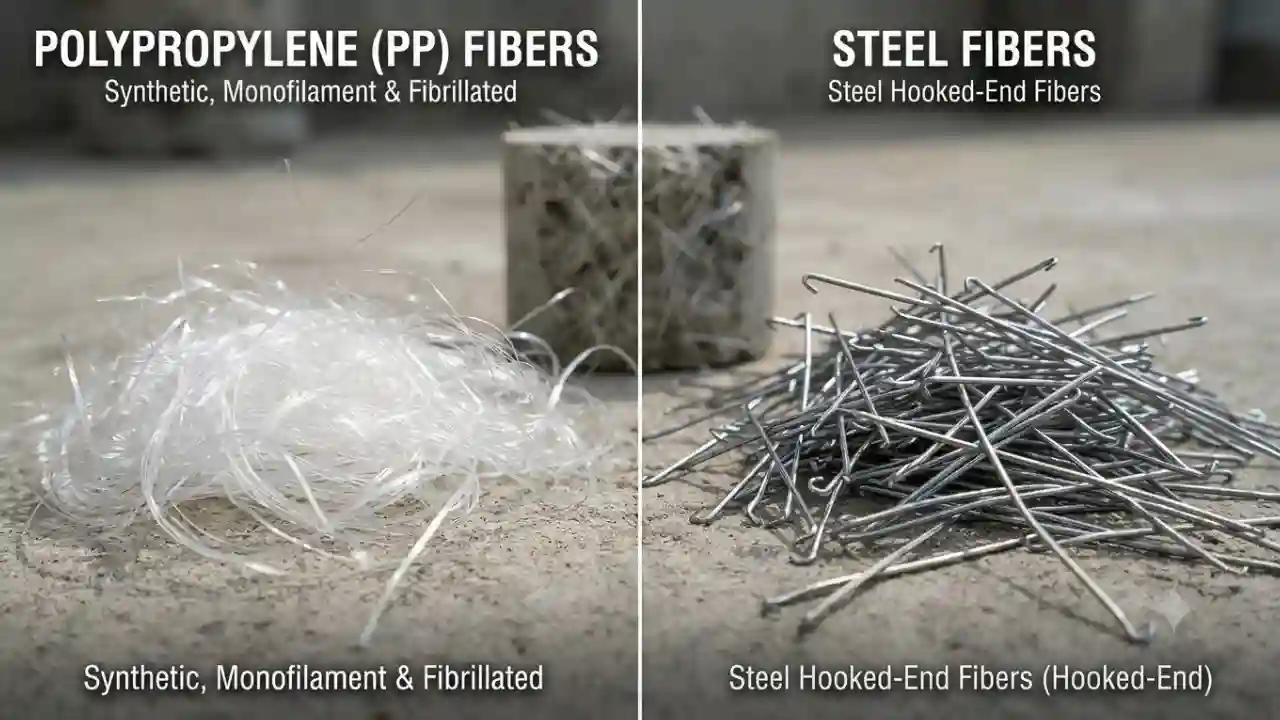
Both of these two fibers can reinforce concrete, but they have different focuses. For your comprehensive understanding, we‘ll compare them across multiple dimensions. The differences include their mechanisms, physical properties, and functions, etc.
1. Different Reinforcement Mechanisms: Crack Control vs Load Transfer
The biggest difference between PP fiber and steel fiber is how they work inside concrete.
PP Fiber
PP fiber mainly works during the early stage of concrete curing. When concrete is first poured, it is still soft and has not truly hardened or set. If exposed to scorching sun, strong winds, or particularly dry weather at this stage, the surface moisture will evaporate rapidly. The surface shrinks while the interior remains wet; this is what we know as plastic shrinkage cracks.
PP fibers are extremely fine and will form a network when dispersed evenly in the concrete. As concrete dries and shrinks, the PP fibers interweave with one another, generating a “pulling force.” The fibers grip the cement tightly from all directions, distributing the tensile stress, and effectively “hold down” the cracks.
Through this network, PP fibers control micro-crack formation, improving the stability of fresh and early-age concrete.
Therefore, you can use PP fibers for:
- Controlling plastic shrinkage cracks
- Reducing early-age crack reduction
- Improving internal cohesion
Steel Fiber
Steel fiber works mainly after concrete cracking occurs. It acts on the later hardening stages of concrete.
After the concrete has hardened, it may still crack under immense external pressure. Steel fiber can bridge the cracks and exert a tensile effect. It addresses the issue of concrete being too brittle and prone to snapping under tension. Steel fiber can withstand heavy loads even after cracking and exhibit ductility similar to that of steel.
The core functions of steel fibers are toughening, flexural resistance, and load-bearing. We can summarize the uses of steel fibers as follows:
- Bridging crack
- Improving toughness
- Enhancing impact resistance
- Better post-cracking performance
2. Physical Properties And Fiber Characteristics
The differences in physical properties between the PP fiber and the steel fiber also led to different reinforcement behavior.
PP Fiber
Made from polypropylene, PP fiber has a density of approximately 0.90~0.91 g/cm³.
With low density, a small weight of PP fiber contains plenty of individual fibers. So PP fibers can be distributed throughout the concrete matrix, providing widespread crack control.
Common PP fiber lengths include:
- 3 mm
- 6 mm
- 12 mm
- 18 mm
Depending on fiber type and manufacturing process, the tensile strength of PP fiber can range from 300 to 700 MPa. But people choose PP fibers is not because of their tensile strength. PP fibres’ value is not to carry loads after cracking, but as a secondary reinforcement.
Steel Fiber
Steel fiber has a much higher density, it is about 7.85 g/cm³. Due to the high density, steel fiber can provide stronger mechanical reinforcement. But conversely, it also increases transportation weight and mixing requirements.
Common steel fiber lengths include:
- 20 mm
- 30 mm
- 40 mm
- 60 mm
Steel fiber tensile strength is commonly around 500~2500 MPa. So steel fiber can provide stronger crack bridging and improve the toughness of hardened concrete.
3. Dosage And Fiber Distribution
PP Fiber
PP fiber is usually added at a lower dosage because of its lightweight structure.
The typical dosage range is 0.6~1.0 kg/m³, and you need to adjust it depending on the special formulation, fiber length, and performance requirement.
Due to its low density, this dosage can provide a large number of distributed fibers throughout the mixture.
Steel Fiber
Steel fiber normally requires a higher dosage because it improves concrete through mechanical reinforcement. A common dosage range is 20~80 kg/m³, and you also need to evaluate based on Load requirements, structural design, and application conditions
4. Durability And Environmental Resistance
PP Fiber
PP fiber is a non-metallic material and does not rust or corrode.
It also has:
- No water absorption
- Good chemical resistance
- Stable performance in alkaline cementitious systems
Because of these properties, PP fiber is suitable for applications exposed to moisture, chemicals, or marine conditions.
Steel Fiber
Steel fiber provides excellent mechanical durability, but it has corrosive risks in aggressive environments.
If you want to achieve long-term performance with steel fiber, you need to consider the following factors:
- Concrete quality
- Fiber exposure
- Environmental conditions
5. Temperature Resistance
PP Fiber
The melting point of PP fiber is about 160~170°C. It is not designed for extremely high-temperature environments, only for normal construction conditions.
Steel Fiber
Steel has a much higher melting point, generally around 1370~1530°C. Due to its metallic structure, steel fiber provides better resistance under high-temperature conditions.
6. Mixing And Construction Handling
PP Fiber
PP fiber is light, so it is easy to transport, store, and mix. You can get related advantages:
- Easy dispersion
- Compatibility with conventional mixing processes
- Lower handling requirements
Steel Fiber
Steel fiber requires more attention during mixing because of its higher weight. You also need to mix them carefully to prevent uneven fiber concentration.
7. Cost Consideration
PP Fiber
PP fiber is generally more economical for crack-control applications. It usually requires a lower dosage and transportation cost.
Its advantages include:
- Lower dosage requirement
- Lower transportation cost
- Easy application
It is commonly selected for mortar, repair materials, and general concrete applications.
Steel Fiber
When using steel fiber, you need more material. Due to the weight, you will also pay more for the delivery charge. However, steel fiber can provide better long-term value for heavy-duty applications.
Material cost is only the initial cost, you also need to consider dosage, transportation, and construction efficiency for the overall cost.
PP Fiber vs Steel Fiber: Quick Comparison
| Property | PP Fiber | Steel Fiber |
| Material | Polypropylene | Steel |
| Main Function | Crack control | Post-cracking reinforcement |
| Density | 0.90–0.91 g/cm³ | Around 7.85 g/cm³ |
| Fiber Length | 3–18 mm | 20–60 mm |
| Tensile Strength | 300–700 MPa | 500–2500 MPa |
| Typical Dosage | 0.6–1.0 kg/m³ | 20–80 kg/m³ |
| Corrosion Resistance | Excellent | Requires consideration |
| Temperature Resistance | Around 160–170°C melting point | Around 1370–1530°C melting point |
| Best Applications | Mortar, repair materials, slabs, precast concrete | Industrial floors, tunnels, heavy-duty concrete |
Are PP Fiber and Steel Fiber Direct Substitutes?
PP fiber and steel fiber cannot replace each other because of their different reinforcement purposes.
PP fiber is used to control early-stage plastic shrinkage. And it can provide better durability and construction efficiency. In contrast, steel fiber focuses on post-cracking bridging and mechanical reinforcement.
For high load resistance applications, PP fiber cannot fully replace steel fiber. For general concrete applications where structural capacity is not the most important, PP fiber can provide a practical solution.
How to Choose Between PP Fiber and Steel Fiber?
After analysing their distinctions in characteristics and functions, you can choose PP fiber and Steel Fiber correctly.
You can choose PP fiber for below purpose:
- Shrinkage crack control
- Corrosion resistance
- Easy mixing and construction
- Cost-effective reinforcement
PP fibers are usually applied in the following scenarios:
- Repair mortar
- Plastermortar
- Concrete slabs
- Precast concrete
You need to choose steel fiber when you want to achieve:
- Higher load resistance
- Impact resistance
- Improved post-cracking performance
Steel fibers are used in:
- Industrial floors
- Tunnels
- Heavy-duty pavements
- Infrastructure projects
So that means you need to consider the type of crack, environmental conditions, construction method, and required performance level for the fiber selection.
In real applications, you may find the combination of PP fibers and steel fibers. This hybrid can complement the strengths of both materials. The PP fibers form a dense micro-network to intercept early plastic shrinkage cracks. At the same time, the steel fibers act as macro-reinforcement to provide post-crack ductility and structural load-bearing capacity. Ultimately, this combination ensures comprehensive crack control throughout the entire lifecycle of the concrete.
Conclusion
Both PP fiber and steel fiber are effective reinforcement solutions. PP fiber focuses on crack control, durability, and easy application. But steel fiber provides stronger post-cracking reinforcement for heavy-duty concrete. With experience in fiber technology and formulation development, Celotech provides superior PP fiber materials and optimizes performance for different construction requirements.
FAQ
1. How Much PP Fiber Should be Added to Concrete?
In general, PP fiber dosage is usually around 0.6~1.0 kg/m³ for normal concrete applications. For special projects, the dosage should be adjusted based on your application, fiber type, and performance requirement.
2. What Types of Concrete Are PP Fibers Suitable for?
PP fiber can be used in various cement-based materials. It is suitable for ready-mix concrete, precast concrete, and shotcrete.
3. What’s the Difference Between Virgin PP Fiber and Recycled PP Fiber?
Virgin PP fiber is produced from new polypropylene material. Generally, new material is better and can provide more consistent physical properties. While recycled PP fiber material is manufactured with recycled material. Recycled PP fiber may lead to variations in final performance.
4. Can PP Fiber Be Used with Other Concrete Additives?
Yes, PP fiber is usually used together with other additives to improve the final result. For example:
- Combine with superplasticizersto improve workability and strength development.
- Mix with HPMCto get better water retention and mortar consistency.
- Using RDPfor better adhesion and flexibility.
5. What Is the Shelf Life of PP Fiber?
PP fiber can be stored for a long period since it is a dry synthetic material.