Introduction
Wall putty performance problems are among the most common challenges faced by dry-mix manufacturers. Issues such as cracking, poor adhesion, powdering, blistering, and poor workability can affect your product reputation, customer satisfaction and repeat orders. it will make big loss of your business or brand. However, wall putty failure is rarely caused by one single ingredient. as we all know that a reliable formulation depends on the balance between below factors:
| Factor | Influence on Performance |
|---|---|
| Raw materials | Strength, consistency, durability |
| Formulation design | Balance between strength and flexibility |
| Additives | Water retention, adhesion, workability |
| Production process | Dispersion and batch stability |
| Application conditions | Final field performance |
This guide helps you identify common wall putty problems, understand their root causes, and select the right improvement strategy.
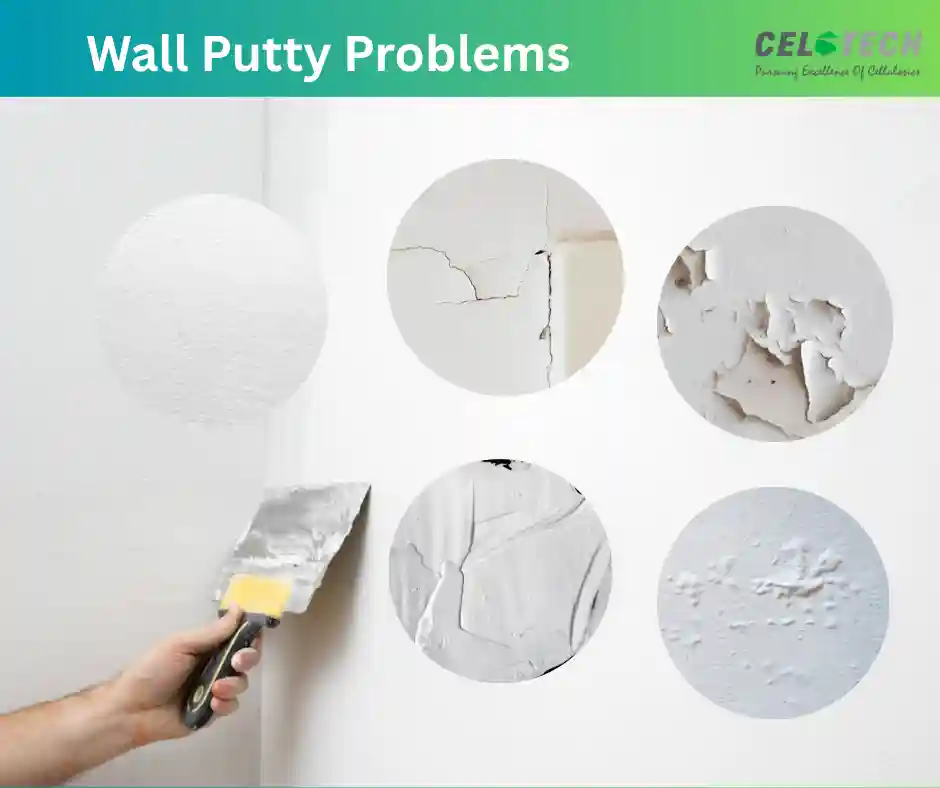
1. Why Does Wall Putty Crack After Drying?
Understanding Wall Putty Cracking
Cracking happens when internal stress exceeds the strength and flexibility of the dried putty layer.
Common crack patterns include:
| Crack Appearance | Possible Causes |
|---|---|
| Cracks within 24 hours | Rapid moisture loss, insufficient water retention, poor curing conditions |
| Cracks after several days | Shrinkage stress, insufficient flexibility, weak adhesion |
| Cracks in thick layers | Uneven drying, excessive application thickness |
Early Cracking: Moisture Control Problems
When cracks appear shortly after application, You should first investigate moisture loss during curing.
For cement-based wall putty, sufficient moisture is required for proper hydration. If water evaporates too quickly, the internal structure may become weaker and shrinkage stress may increase.
Common factors you should pay attention are:
- Highly absorbent substrates
- Dry environmental conditions
- Insufficient water retention
Cellulose ether such as HPMC/MHEC helps maintain moisture availability and improves curing stability.
Late Cracking: Flexibility and Stress Problems
Cracks that appear after several days or weeks usually indicate different issues. The formulation may lack sufficient flexibility to absorb:
- Substrate movement
- Temperature variation
- Drying stress
RDP improves polymer modification and helps increase:
- Adhesion strength
- Flexibility
- Crack resistance
2. Why Does Wall Putty Lose Adhesion or Peel Off?
Common Symptoms you can see in your daily project as below, the sheet has a clear expression on root-why-how to improve the performance, you can take as a reference:
- Putty detaches from the substrate
- Hollow areas appear
- Paint adhesion becomes poor
| Root Cause | Why It Happens | Improvement Direction |
|---|---|---|
| Poor substrate preparation | Dust or weak surface reduces bonding | Improve surface preparation |
| Insufficient polymer modification | Dry layer lacks flexibility and bonding strength | Optimize RDP |
| Poor water retention | Incomplete hydration weakens structure | Optimize cellulose ether |
3. Why Does Wall Putty Become Powdery After Drying?
Powdering usually indicates insufficient surface strength. The problem often occurs when the dried putty structure cannot properly bind particles together.
| Possible Cause | Explanation |
|---|---|
| Insufficient hydration | Water loss prevents complete cement reaction |
| High filler ratio | Binder strength becomes insufficient |
| Poor water retention | Moisture is unavailable during curing |
Improvement requires balancing:
- Binder content
- Water retention
- Curing conditions
4. Why Does Wall Putty Bubble or Blister?
Blistering is often related to trapped air, uneven drying, or rheology problems.
| Problem | Possible Reason |
|---|---|
| Bubbles during application | Poor mixing or trapped air |
| Bubbles after drying | Porous substrate or uneven moisture movement |
| Surface blistering | Excessive thickness or unsuitable rheology |
The ways to reduce blistering, you can try:
- Improve mixing quality
- Control application thickness
- Optimize rheology
- Prepare substrates properly
5. Why Is Wall Putty Difficult to Apply?
A high-quality wall putty should provide:
- Smooth spreading
- Good trowel feel
- Easy leveling
- Sufficient working time
Poor workability often comes from an unbalanced rheology system.
| Condition | Possible Result |
|---|---|
| Too low viscosity | Poor consistency and insufficient water retention |
| Too high viscosity | Difficult spreading and poor leveling |
Cellulose ether selection directly influences:
- consistency
- water retention
- open time
- application experience
6. Why Does Exterior Wall Putty Fail More Easily?
For many exterior wall applications, you may face additional challenges like: rain exposure, temperature changes, weathering and substrate movement. because compared with interior wall putty, exterior wall putty formulations require stronger durability. comparision as below:
| Requirement | Important Performance |
|---|---|
| Water resistance | Protection against moisture |
| Flexibility | Resistance to movement stress |
| Crack resistance | Long-term durability |
Notes: RDP and cellulose ether work together to improve exterior performance.
7. How Do Additives Improve Wall Putty Performance?
Cellulose Ether (HPMC/MHEC) are the best additives to improve the wall putty performance significantly. they play different function in the formulation.
| Function | Performance Benefit |
|---|---|
| Water retention | Better curing |
| Rheology control | Improved workability |
| Open time extension | Better adjustment during application |
| Consistency control | Stable application performance |
Redispersible Polymer Powder (RDP) is used for improve the adhesion ability mostly.
| Function | Performance Benefit |
|---|---|
| Polymer film formation | Improved bonding |
| Flexibility improvement | Reduced cracking risk |
| Durability enhancement | Better long-term performance |
Cellulose Fiber is used to enhance the structure strength of wall putty.
| Function | Performance Benefit |
|---|---|
| Reinforcement | Improved structural stability |
| Crack control | Reduced crack propagation |
8. How Do Manufacturers Evaluate Wall Putty Performance?
Before changing formulation parameters, manufacturers should confirm the actual failure mechanism through testing.
| Test | Purpose |
|---|---|
| Adhesion strength test | Evaluate bonding performance |
| Water retention test | Measure moisture control ability |
| Crack resistance evaluation | Assess stress resistance |
| Workability test | Evaluate spreading and application |
| Surface inspection | Check powdering, blistering and finish |
9. A Manufacturer’s Approach to Improving Wall Putty Quality
A stable wall putty formulation requires more than selecting a single additive. as a mature manufacturer, you should evaluate the complete system as listed:
| Area | Key Considerations |
|---|---|
| Raw materials | Consistency, quality variation |
| Formulation | Strength, flexibility, workability balance |
| Additives | Correct function and compatibility |
| Production | Mixing and dispersion |
| Application | Substrate and curing conditions |
The goal is not simply increasing additive dosage, but selecting the right additive combination for the required performance
FAQ
Can HPMC prevent wall putty cracking?
HPMC helps reduce cracking risk by improving water retention and curing conditions. For flexibility and crack resistance, polymer modification such as RDP is often required.
What causes wall putty peeling?
Peeling is usually related to poor substrate preparation, insufficient bonding strength, weak hydration, or insufficient polymer modification.
Why does wall putty become powdery?
Powdering usually results from weak surface structure caused by incomplete hydration, poor binder balance, or insufficient water retention.
Final Conclusion
Producing reliable wall putty requires balancing strength, flexibility, water retention, and workability.
By understanding failure mechanisms and selecting suitable additives, manufacturers can improve:
- adhesion
- crack resistance
- durability
- application performance
Celotech provides cellulose ether and performance additives designed to help wall putty manufacturers optimize formulations and develop more reliable dry-mix products.