Introduction
As two types of ready-mixed mortar, dry mix mortar and wet mortar are alternatives to traditional site-mixed mortar. They are commonly applied in modern constructions and can improve construction quality, but have several differences you should know. This article provides a comprehensive comparison, helping you to choose the right mortar
What Is Dry Mortar?
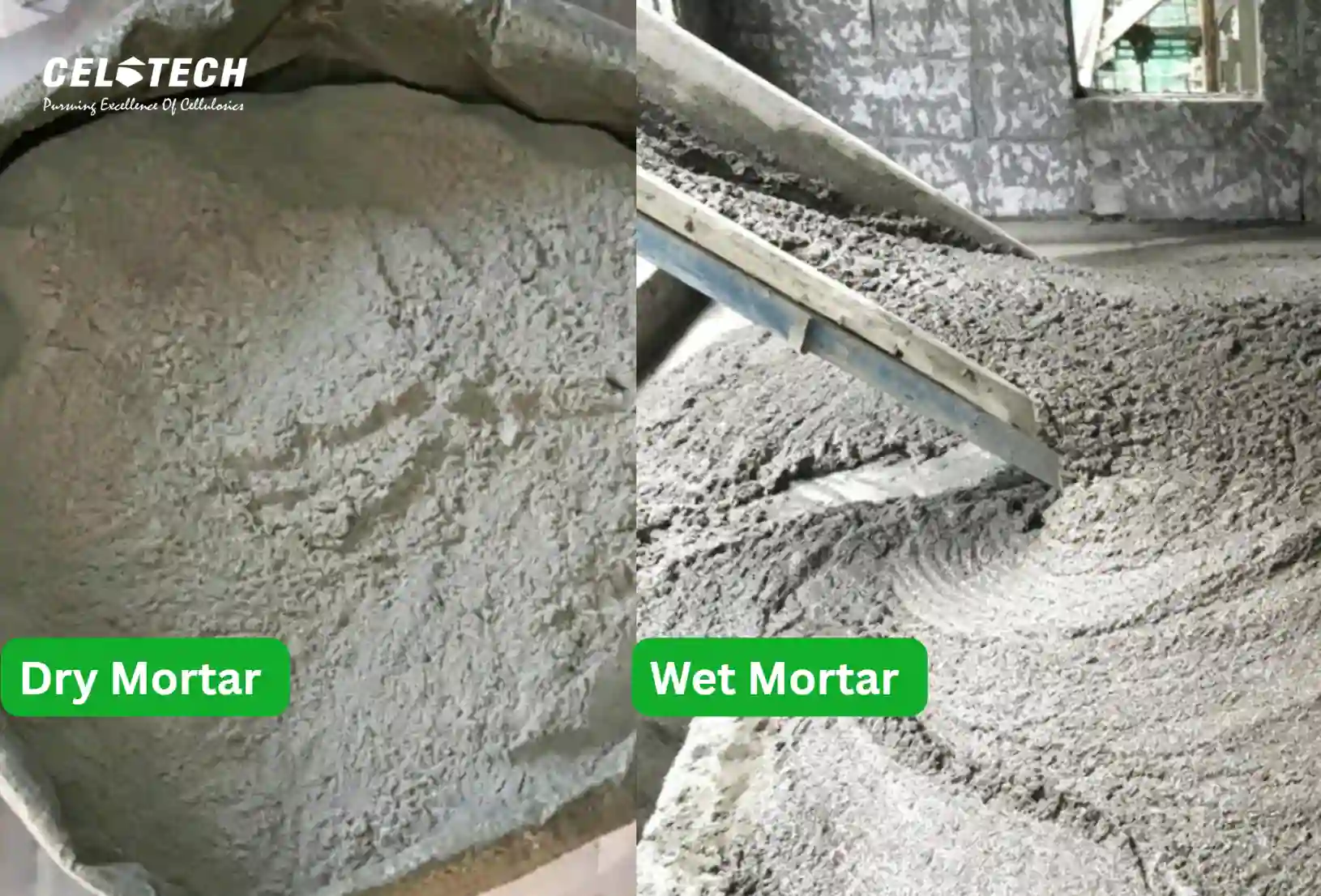
Dry mortar equals dry mix mortar, which is in powder form. It is made of cement, aggregates, fillers, and functional additives. All these ingredients are accurately measured and blended under controlled production conditions. Construction workers only need to mix the material with water based on the recommended ratio.
More advanced than traditional cement-sand mortar, dry mix mortar is an engineered system for specific applications.
What Is Wet Mortar?
Wet mortar is delivered in a ready-to-use state, so it is also called ready-mixed mortar. Mortar mixture that is centrally mixed at a mixing station or plant. In addition to cement, aggregates, and other components, wet mortar is already mixed with water. The fully mixed finished product will be transported directly to the construction site via specialized transport vehicles.
The material arrives ready for application, which reduces on-site preparation work.
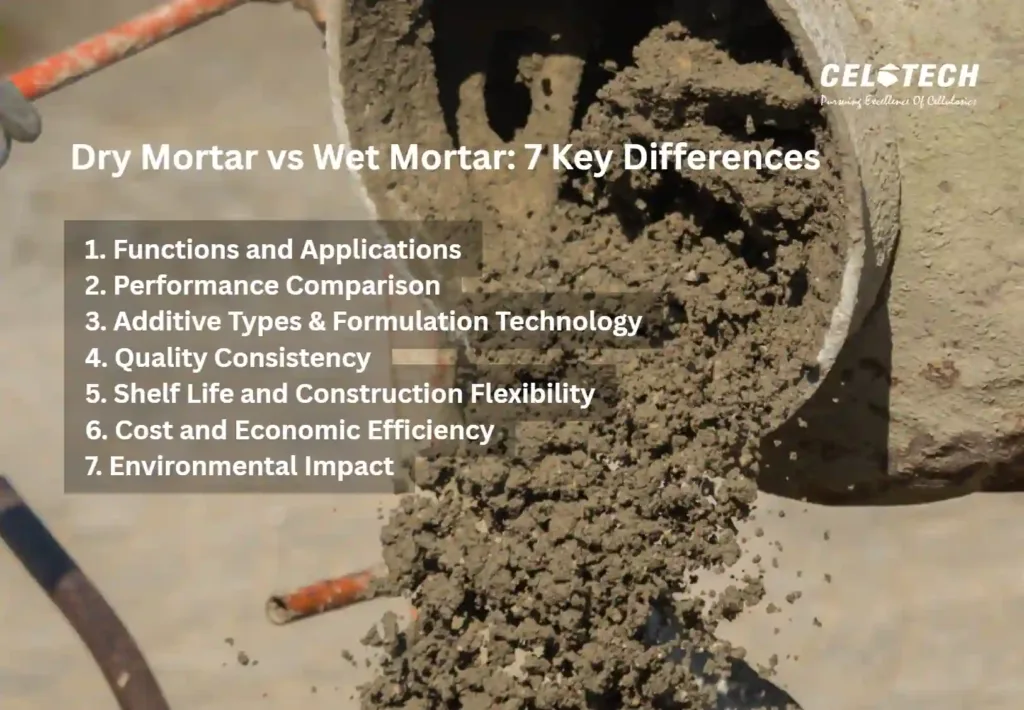
Dry Mortar vs Wet Mortar: 7 Key Differences
Based on their physical forms and production methods differences, you can not make an informed choice between dry mortar and wet mortar. We will provide an in-depth comparative analysis of the two mortar types from the following 7 dimensions:
1. Functions and Applications
Dry-mix mortar has multifunctions and mainly focuses on “specialized chemical modification”. It is unconstrained by specific production methods and contains a vast array of high-value-added specialty mortars. These include tile adhesives, self-leveling compounds, EIFS mortars, waterproofing mortars, grouting mortars, interface agents, etc. You can use dry mortars in high-end modern construction and renovation projects.
Wet mortar has a relatively limited function, focusing primarily on “basic physical filling.” Due to the constraints of wet-state production processes, it is unsuitable for producing high-viscosity mortars. Therefore, you can only apply wet mortar in standard tasks such as masonry, plastering, floor leveling, and basic waterproofing.
2. Performance Comparison
Dry-mix mortar has superior mechanical performance. The dry powder state is susceptible to segregation due to differences in particle gradation between sand and additives. But mixing with specialized chemical additives, it can achieve exceptional flexibility, crack resistance, and high bond strength. So you can use dry mix mortar under extreme or complex stress conditions.
Wet mortar has a stable physical state as it is inherently homogeneous. The components are evenly distributed after mixing with water at the batching plant. However, wet mortar only has standard performance, such as 28-day compressive strength, tensile bond strength, and water retention. Due to the limitations of the wet-mixing process, it is difficult to achieve high flexibility through polymer modification. Hence, you should evaluate the factor of stress before using wet mortar.
3. Additive Types & Formulation Technology
In dry-mix mortar, all additives are powders and will not react chemically during dry blending. They will only disperse fully and become active after adding water at the site. Key additives in dry-mix mortar include cellulose ethers (e.g., HPMC), redispersible polymer powders(RDP), starch ethers, and superplasticizer. For formulation design, you should focus on powder compatibility, rapid solubility in cold water, and the mechanical property enhancement.
Additives for wet-mixed mortar are typically in powder or liquid form. They can be dissolved or diluted directly upon the addition of water at the mixing plant. The core additive types are “plasticity stabilizers” and high-performance retarders. As we know, wet mortar needs to maintain stable workability for several hours to 24 hours. So in the formulation, you should emphasize maintaining plasticity, preventing sagging, and avoiding segregation.
4. Quality Consistency
Dry mortar can have better consistency between batches. It does not undergo premature hydration in the dry powder state. So the quality can be relatively stable after passing the laboratory tests. After arriving at the construction site, the buffering effect of high-quality additives provides strong resistance to fluctuations in temperature and humidity. Even if your local workers have poor workmanship, you will not face large-scale rework or customer complaints.
Wet mortar contains water upon leaving the plant and is effectively on a “countdown” clock. The quality can be influenced by delivery time and site conditions significantly. Traffic congestion during transport, moisture loss due to intense sun exposure, or the improper addition of water by workers can disrupt the original water-binder ratio. It can cause a drastic drop in mortar strength and create hollow spots and cracking later on.
5. Shelf Life and Construction Flexibility
Dry mortar is usually packed in bulk or bags, and you just need to stack them in a dry, well-ventilated place at a proper temperature. The shelf life can be as long as6 to 12 months. It is suited for intermittent or small-batch operations. You can use it more flexibly according to the actual construction schedule.
While wet mortar can only be stored in specialized airtight containers (such as mortar tubs) for hours. It must be used before it sets, and the maximum time is 12 hours. In practical engineering, there are often only 4 hours available. It has high requirements for construction scheduling and usage estimation.
6. Cost and Economic Efficiency
You should assess the overall cost and economic efficiency of dry mortar and wet mortar. We will primarily compare the cost differences from the 3 aspects below.
Raw Material Costs
The raw material cost for dry-mixed mortar is relatively high. On one hand, its aggregates (sand) require high-temperature drying, which increases processing costs. On the other hand, the material cost is higher due to the additional functional additives to achieve superior performance.
In contrast, the raw material costs for wet mortar are lower. It does not need expensive drying processes since it utilizes washed sand or manufactured sand directly. Furthermore, wet mortar can be produced at existing ready-mixed concrete plants. You do not need to purchase new dry-mix blending equipment. Wet mortar requires lower initial capital expenditure and a relatively simple production process.
Transportation Costs
The transportation of dry-mix mortar is flexible and cost-effective. Without water, it can be transported by standard trucks and exported to different countries by sea. Dry mortar has high logistical flexibility without geographical constraints.
Wet mortar requires higher costs and has more limitations on transportation. Containing 17%–19% moisture, it requires specialized agitator trucks for transport to prevent segregation. In many global markets, the practical transportation radius is often limited to around 30–50 km.
Waste and Hidden Costs
Dry mortar has an extremely low waste rate. Mixed with water on-site for immediate use, material loss is typically kept within 3%–5%. Its long shelf life and on-demand usage eliminate the risk of discarding leftover slurry. Additionally, it enables high construction efficiency, helping you reduce subsequent repairs or rework.
Wet mortar is more prone to causing waste as it must be used within a few hours. Any unexpected factors like traffic congestion, sudden weather changes, or site work stoppages can cause the material to set beyond its usable window. What’s worse, it may lead to the loss of the entire batch. Moreover, adding water on-site or allowing the material to sit for too long will cause a drastic drop in strength. Consequently, you will have high costs for rework.
Different countries have differences in the material, labor, and fuel costs. You need to comprehensively calculate the costs of dry mortar and wet mortar according to the local real conditions.
7. Environmental Impact
In modern construction, people are placing increasing importance on sustainability. Both dry mix mortar and wet mortar can be produced and used in compliance with global environmental regulations.
Compared to wet mortar, dry-mix mortar has more advantages in environmental protection. It can reduce material waste and increase transportation efficiency. Since the mixing is produced by factory facilities, the production dust can be better controlled. Of course, you should manage the dust pollution caused by on-site mixing.
Wet-mix mortar also reduces dust emissions during application. However, it entails more complex logistics. For equipment cleaning, it will cause wastewater, and you also need to manage the surplus materials.
Dry Mix Mortar vs Wet Mortar: Comparison Table
| Factor | Dry Mix Mortar | Wet Mortar |
| Form | Powder; Add water on site | Wet-mixed state with water; Ready-to-use |
| Applications | More specialized solutions | Mainly conventional mortar |
| Performance | High customization with additives | Limited customization |
| Quality Stability | Better consistency | Affected by transport & site conditions |
| Shelf Life | 6–12 months | 4–12 hours |
| Transportation | Longer-distance; Support exporting | Usually 30–50 km radius |
| Cost | Higher material cost, lower waste | Lower initial cost, higher logistics limits |
| Environmental Impact | Less water transport, better production control | More cleaning wastewater management |
How to Choose Between Dry Mix Mortar and Wet Mortar for Real Projects?
After understanding the above differences between dry mix mortar and wet mortar, you can know how to choose them better. In real projects, we also select the mortar type according to the project scales or combine them together.
When to Choose Dry Mix Mortar
- The applications are tile adhesive, wall putty, or other special scenarios.
- The construction area is relatively small (below 100–500 m²).
- The project is located far from the mortar production plant or requires flexible material storage.
- You need customized performance and a stable formulation.
When to Choose Wet Mortar
- Large quantities of conventional mortar are needed continuously, such as for masonry or plastering works.
- The construction area is large (for example, above 500–1,000 m²).
- The project is close to a ready-mixed mortar plant (typically within a limited transportation radius).
When to Combine Dry Mortar and Wet Mortar
In some projects, combining both solutions can provide better efficiency. Wet mortar can be used for high-volume basic applications, while dry mix mortar is more suitable for performance-focused applications, including tile adhesives, repair mortars, and self-leveling systems.
Conclusion
Dry mix mortar and wet mortar both have their own advantages. Wet mortar is suitable for local, high-volume applications, while dry mix mortar provides greater flexibility, stable quality, and customized performance. As a leading dry mix mortar additive supplier, Celotech provides various grades of cellulose ether, RDP, and other additives with formulation support for dry mix mortar systems.
FAQs
Q: Can Dry Mix Mortar Replace All Types of Wet Mortar?
A: No. Dry mix mortar can replace many traditional mortar applications, but wet mortar is still practical for large-volume basic applications with nearby supply.
Q:Why Does Dry Mix Mortar Sometimes Have Poor Performance?
A: Poor performance of dry mix mortar can be caused by many factors. You can check if the formulation, additive dosage, compatibility, and mixing are proper or not.
Q:How to Select the Right Additives for Dry Mix Mortar?
A: You can choose the dry mix mortar additives based on mortar application, targeted performance, and local site conditions.
Q:How to Reduce the Production Costs of Dry Mix Mortar?
A: You can optimize the cost by adjusting the raw material and formulation.
Q:Does Climate Affect Dry Mix Mortar Formulation?
A: Yes, extreme climate, humidity, and drying speed can influence mortar performance. You’d better test and adjust based on the local weather variation.