Table of Contents
Introduction
1. Why Pregelatinized Starch Performs Differently?
2. Role of Pregelatinized Starch in Cellulose Ether Systems
3. Why Pregelatinized Starch from Different Suppliers Performs Differently
4. Real Construction Performance Depends More on Rheology Balance Than High Viscosity
5. Batch-to-Batch Consistency Is Critical for Industrial Production
6. How to Identify Whether a Supplier Understands Applications or Only Sells Specifications?
7. Celotech as an Application-Oriented Pregelatinized Starch Supplier
8. Conclusion
9. FAQ
Introduction
Most construction material manufacturers usually evaluate pregelatinized starch suppliers by sample testing, technical specifications, and cost. Although the samples were tested well in the laboratory, performance issues still appear during mass production or on-site application.
We cannot judge the real performance of pregelatinized starch by a single parameter, or focus too heavily on pregelatinized starch price. Therefore, when selecting a pregelatinized starch supplier, it is important to verify whether they have the ability to deliver such performance consistently. Key factors as:
- Material’s stability
- Consistency
1. Why Pregelatinized Starch Performs Differently
In neutral wall putty and gypsum-based dry mix systems, there is a common real production issue: some pregelatinized starch products have very similar viscosity data and laboratory results, but their field performance is completely different.
Even with the same formulation, some brands of pregelatinized starch provide smooth application, good sag resistance, and stable open time. While others may feel dry during application, show unstable workability, or cause fluctuations in water retention.The hidden factors for real application performance in practical formulation work.
- Viscosity
- Hydration behavior
- Compatibility with cellulose ether systems,
- Overall rheology balance
This is also one of the most common challenges are different starch performance can fluctuate during mass production or field application from different suppliers. Even if the laboratory test data meet all technical requirements. The discrepancy becomes more obvious under high-temperature construction conditions resulting in inconsistent application performance because below factors:
- Rheology changes
- Unstable trowel feel
- Shorter open time
It is difficult to identify such problems by standard laboratory testing alone, but they will become significant under real construction conditions.
That is to say, laboratory data alone cannot fully predict field behavior. You need to consider system compatibility when evaluating reliable pregelatinized starch suppliers.
2. Role of Pregelatinized Starch in Cellulose Ether Systems
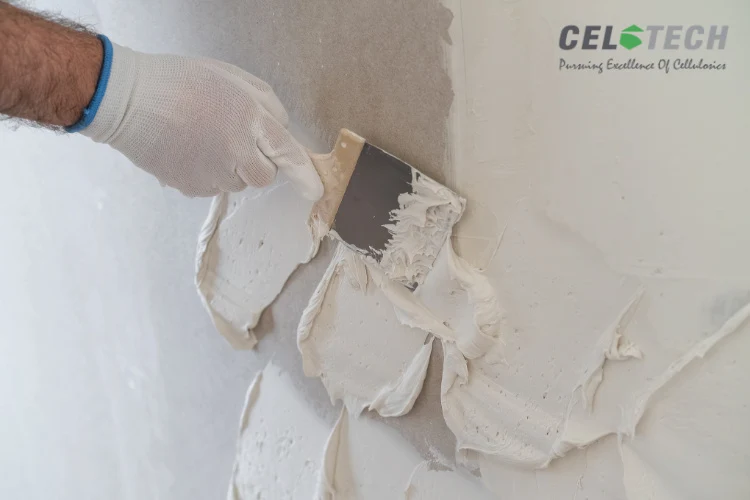
Pregelatinized starch does not work independently, it is synergized in neutral wall putty, gypsum-based formulations, and low-alkaline dry mix systems with other additives, rather than as only a low-cost thickening agent.
The real value is driven by its synergy with cellulose ethers such as Hydroxypropyl Methyl Cellulose (HPMC) and Methyl Hydroxyethyl Cellulose (MHEC).
- Rheology adjustment
- Workability improvement.
- Smooth application
- System stability while controlling formulation cost
The biggest difference between high-quality and low-quality starch products lies in the compatibility behavior inside the formulation system. Poorly controlled products may absorb water too rapidly and interfere with the water retention network formed by HPMC or HEMC. These may cause faster drying, shorter open time, unstable trowel resistance, or poor workability in practical construction conditions.
These problems are difficult to fully reproduce in small-volume tests in the lab, but can become much more obvious during summer construction, large-area application, or thick-layer application.
3. Different Suppliers Performs Differently Performance: Raw Materials, Processing, and Particle Structure
Although many pregelatinized starch products are similar in technical data, the real differences come from raw materials and process control capability.
The most common raw materials are corn starch and tapioca starch. Different starch sources naturally show:
- Different molecular structures,
- Water absorption behavior
- Rheological properties
Differences in amylose and amylopectin ratios also affect hydration speed and structure formation inside the formulation system.
The production process is equally important. Gelatinization uniformity, drying control, and particle structure management all influence final application behavior.
Another overlooked factor is particle strength and structural stability. Under high shear mixing conditions, weak particle structures may break down more easily. This can cause rheology loss and unstable workability during application. Moisture content and drying consistency are important, too. Poor moisture control may increase the risk of caking during storage and affect hydration consistency between batches.
These factors are rarely fully reflected in standard COA documents, but they are often the real reason behind “same specification, different performance”.
From an application perspective, these microscopic structural differences are one of the main sources of field performance variation.

4. Real Construction Performance Depends More on Rheology Balance Than High Viscosity
Many purchasers and junior formulators believe that higher viscosity equals better quality. However, excessively high apparent viscosity does not always improve application performance in neutral and low-alkaline systems.
In many cases, it may increase trowel resistance and reduce spreadability. Real rheology balance is not about simply increasing or lowering viscosity. It means maintaining stable structure during mixing, application, and resting, while still allowing smooth flow and workable consistency.
This is a dynamic balance rather than single-parameter optimization. In practical application, this balance directly affects construction behavior. For example, wall putty and gypsum-based systems require enough structural support to reduce sagging, while still maintaining smooth and efficient application. If the system loses balance, two opposite problems may appear: excessive sagging or difficult troweling.
Therefore, a stable pregelatinized starch system is not designed to maximize viscosity, but to help maintain controllable rheology and consistent application behavior.
5. Batch-to-Batch Consistency Is Critical for Industrial Production
For large-scale dry mix manufacturers, even small performance fluctuations can lead to serious quality problems.
Actually, most customers are not concerned about whether the additive is “strong enough”. What they value most is the consistent performance between batches.
The stability of pregelatinized starch depends heavily on production control. Traditional production methods often rely on operator experience to manage gelatinization temperature and drying conditions. This can easily create batch variation in hydration speed, thickening behavior, and formulation compatibility.
Modern standardized production systems usually rely on PLC or DCS process control to stabilize key production parameters and improve consistency.
From a practical application perspective, this consistency is one of the most important factors in reducing field performance fluctuations.
6. How to Identify Whether a Supplier Understands Applications or Only Sells Specifications?
Many pregelatinized starch suppliers mainly provide COA data and basic technical specifications. However, real formulation problems cannot be solved by specifications alone. A valuable supplier is defined more by application understanding than by supply capability.
One simple way to identify this difference is through communication logic. Trading-oriented suppliers usually recommend standard grades without fully understanding your formulation system or construction conditions.
Application-oriented suppliers should evaluate
- System type
- Construction environment
- Temperature conditions
- And cellulose ether combinations
They can also identify potential risks such as water competition, rheology instability under shear, or temperature-related workability changes.
This type of formulation understanding is often more valuable than specification comparison alone.
7. Celotech as an Application-Oriented Pregelatinized Starch Supplier
Celotech is not only one of the leading pregelatinized starch suppliers in China, but also supports customers in solving practical formulation and application problems.
Our technical support network includes application teams and laboratory resources in multiple regions worldwide. These facilities enable our teams to provide performance evaluation, compatibility testing, and formulation analysis. And we focus on jobsite technical support for different construction conditions, cellulose ether systems, and formulation environments.
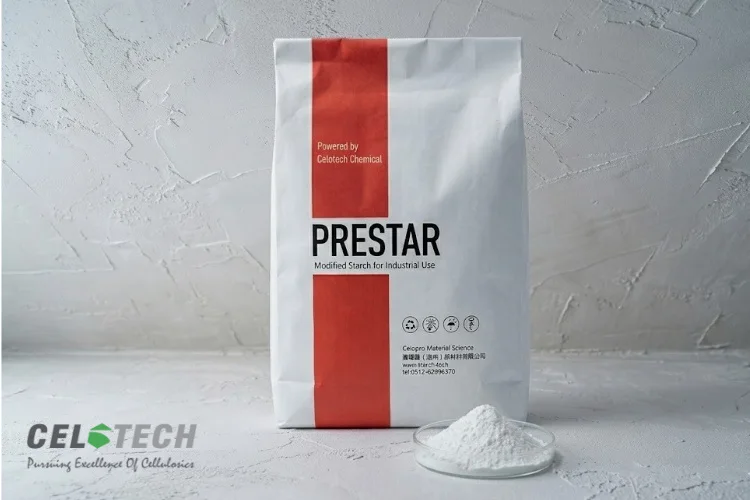
Celotech Prestar® pregelatinized starch products are used in various neutral and low-alkaline construction systems for rheology adjustment, workability optimization, and formulation cost control.
From our perspective, long-term system stability is more important than single-parameter performance alone.
8. Conclusion
Choosing a pregelatinized starch supplier can’t just decide by comparing viscosity data or price. The real goal is to select a material that can maintain long-term compatibility within the formulation system under considering technical parameter:
- System compatibility
- Rheological stability
- Batch consistency
- Field adaptability
FAQ:
Q1: How Does Your Product Compare With Other Pregelatinized Starch Suppliers?
A: Celotech focuses not only on viscosity and other basic specifications. We test and combine the real application conditions with hydration stability, cellulose ether compatibility, and rheology consistency. Our brand Prestar™ pregelatinized starch products are developed for practical formulation performance, not just laboratory data.
Q2: How Do You Test Compatibility with Cellulose Ether in Real Systems?
A: We evaluate compatibility through practical formulation testing together with HPMC or MHEC systems. Besides testing workability, water retention behavior, rheology stability, and open time, we also test application performance under different mixing and temperature conditions and provide on-site practical testing when needed.
Q3: Can You Ensure Batch Consistency for Pregelatinized Starch?
A: We control the consistency from the raw material, and our plant has automated control systems to control key production parameters. Additionally, our laboratory, QA, and QC departments work in close coordination across every stage to ensure consistent quality and batch-to-batch stability.
Q4: What’s the Difference Between Celotech Prestar™ 1027 and Prestar™ 1105?
A: Celotech pregelatinized starch Prestar™ 1027 is modified starch from natural corn, standard interior wall putty & general gypsum systems (cost-performance focus). While Prestar™ 1105 is made from cassava, it is better for higher-stability-demand systems and tougher construction conditions
Q5: Can Pregelatinized Starch Be Used in Tile Adhesive?
Pregelatinized starch is generally better to use in neutral or mildly alkaline systems due to pH resistance. If for high-alkaline tile adhesive systems, we recommend starch ether instead, which has better stability and performance compatibility in strong alkaline environments.
More Readings:
What’s the difference between raw starch and pregelatinized starch?
Pregelatinized Starch for Drilling Fluids – Cost-Effective & Eco-Friendly
How Pre-Gelatinized Starch Enhances the Performance of Eco-Friendly Interior Wall Putty