Hydroxyethyl Cellulose (HEC) is widely recognized as a commonly used thickener, rheology modifier, and stabilizer in waterborne coating formulations. However, the key question remains: how to choose an HEC product that perfectly fits your specific formulation requirements, and how to avoid the hidden risks associated with conventional alternatives?
As a global supplier with four robust manufacturing facilities, CELOTECH has leveraged deep process expertise in cellulose ether chemistry to develop specialized solutions for the construction coatings industry. We understand that performance hinges not just on initial viscosity, but on long-term stability and ease of processing.
The Celopro HLB Series: A Superior Modified HEC Solution
Celopro HLB series, a modified HEC product line from CELOTECH, offers excellent color development and thixotropic properties, making it highly recommended for high-PVC (Polyvinyl Chloride) coatings. Notably, it serves as a viable and superior alternative to conventional Hydroxyethyl Cellulose grades, as well as Ethyl Hydroxyethyl Cellulose (EHEC) and Methyl Ethyl Hydroxyethyl Cellulose (MEHEC).
Why Conventional EHEC and MEHEC Grades Fail
Common EHEC and MEHEC products available on the market exhibit several inherent drawbacks that complicate production and compromise the finished product’s longevity.
A. The MEHEC Dissolution and pH Challenge
MEHEC is highly sensitive to the pH value and temperature of the dissolving environment. This high sensitivity often stems from the non-uniform substitution pattern of the methyl groups.
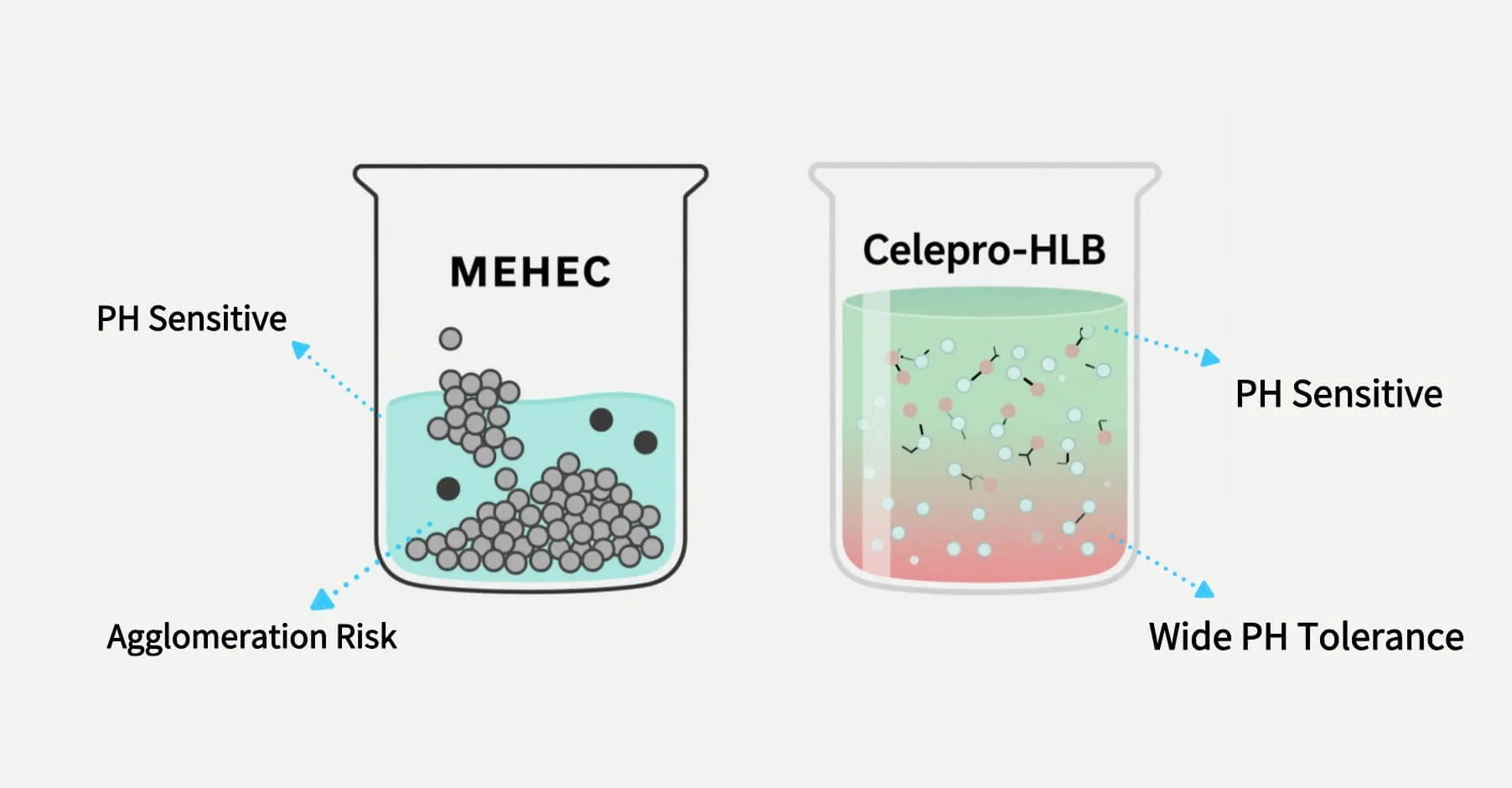
pH Dependence: It tends to agglomerate rapidly in alkaline solutions, particularly during the initial water addition phase, as the high pH environment impedes the necessary hydration process. Conversely, its dissolution rate becomes excessively slow in neutral or acidic aqueous systems.
Temperature Control: Additionally, elevated temperatures can accelerate its dissolution abnormally, posing operational challenges during production and making batch-to-batch consistency difficult to maintain.
Process Costs: To mitigate these issues, additional measures such as pre-dissolution or using weakly acidic water for preparation are required, which inevitably increases process costs and manufacturing time.
Foaming Issues: Furthermore, MEHEC is prone to foaming during the grinding process, often due to residual surface-active impurities and the nature of its substitution, necessitating the pre-addition of defoamers and further complicating the production workflow.
B. EHEC‘s Viscosity and Stability Limitations
As for standard EHEC grades, most are characterized by low viscosity and poor enzyme resistance.
Enzyme Degradation Risk: These products are highly susceptible to enzymatic degradation under specific environmental conditions. Enzymes from bacterial contamination, even at trace levels, cleave the beta-1,4-glycosidic bonds in the cellulose backbone.
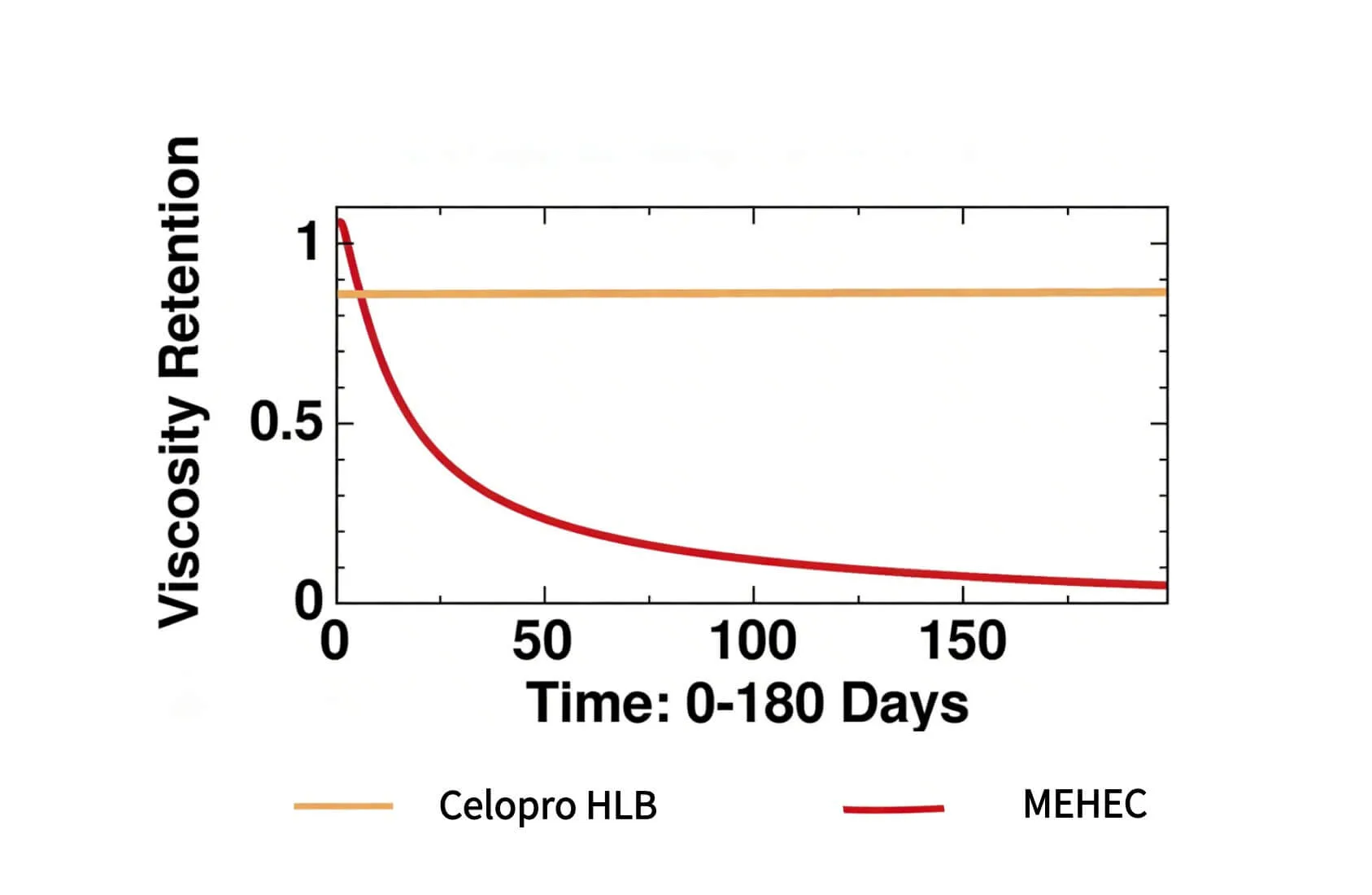
Performance Loss: When applied in waterborne coatings, cementitious materials, or similar products requiring long-term storage, this degradation leads to rapid depolymerization and catastrophic viscosity loss, ultimately compromising the product’s shelf life and performance. This is a critical longevity concern for manufacturers guaranteeing product life.
The Celotech Advantage: Engineered HEC for Stability and Ease
In contrast, the Celopro HLB series effectively resolves or minimizes these aforementioned issues. Since its launch by CELOTECH, this modified HEC product line has been widely adopted by coating manufacturers and garnered consistent acclaim.
1. Optimized Dissolution Mechanism
The Celopro HLB series utilizes a specialized surface treatment during manufacturing. This modification provides a delayed controlled dissolution mechanism, ensuring smooth, lump-free hydration across a wide range of pH and electrolyte levels—solving the primary pain points associated with MEHEC.
2. Superior Enzyme Resistance
The HLB series’ optimized molar substitution (MS) profile creates a physical and chemical shield around the cellulose backbone. This increased substitution degree physically protects the glycosidic bonds from enzymatic attack, resulting in superior long-term viscosity stability and a longer, more predictable shelf life.
3. Streamlined Production and Quality Assurance
Beyond retaining the core functional benefits of traditional HEC (thickening, anti-sagging), the Celopro HLB series addresses the dust-related concern by offering low-dust formulations due to optimized particle size distribution and anti-caking agents. This simplification of the production workflow reduces the need for extensive pre-dissolution or defoamer pre-addition.
Practical Selection Guide: Matching HEC Grade to Application
Choosing the right HEC requires balancing desired rheology with application requirements.
Use Surface-Treated grades for rapid and consistent batch preparation.
Long-Term Storage Products
Exceptional enzymatic resistance.
Use Celopro HLB series specifically engineered for long-term viscosity retention.
Conclusion
For coatings manufacturers, selecting a cellulose ether is a strategic decision that impacts final performance, production cost, and product longevity. While conventional EHEC and MEHEC present inherent processing and stability liabilities, the CeloproHLB series from CELOTECH offers a reliable, engineered solution that solves these challenges.
Our commitment, backed by four advanced manufacturing plants and continuous investment in product R&D, ensures you receive not just a product, but a comprehensive solution for achieving superior rheology, stable viscosity, and simplified production.
Ready to simplify your formulation? Explore our full range of [HEC Products and Technical Data Sheets] or contact our global technical team for a direct consultation. [Contact Celotech Technical Support]
We value your privacy
We use cookies to enhance your browsing experience, serve personalised ads or content, and analyse our traffic. By clicking "Accept All", you consent to our use of cookies.
Customise Consent Preferences
We use cookies to help you navigate efficiently and perform certain functions. You will find detailed information about all cookies under each consent category below.
The cookies that are categorised as "Necessary" are stored on your browser as they are essential for enabling the basic functionalities of the site. Show more
>Necessary
Necessary cookies are required to enable the basic features of this site, such as providing secure log-in or adjusting your consent preferences. These cookies do not store any personally identifiable data.
>Functional
Functional cookies help perform certain functionalities like sharing the content of the website on social media platforms, collecting feedback, and other third-party features.
>Analytics
Analytical cookies are used to understand how visitors interact with the website. These cookies help provide information on metrics such as the number of visitors, bounce rate, traffic source, etc.
>Performance
Performance cookies are used to understand and analyse the key performance indexes of the website which helps in delivering a better user experience for the visitors.
>Advertisement
Advertisement cookies are used to provide visitors with customised advertisements based on the pages you visited previously and to analyse the effectiveness of the ad campaigns.