Basement floor leveling is not just a surface preparation task. It is a moisture-affected concrete substrate system problem, where performance depends heavily on environmental conditions beneath and around the slab.
Unlike standard interior floors, basement slabs are influenced by:
- Subgrade moisture migration
- Long-term humidity variation
- Structural settlement over time
These factors directly affect leveling system performance, bonding stability, and long-term durability.
1. Basement-specific problems
1.1 Moisture from below slab
Moisture can continuously migrate upward through concrete due to vapor transmission from soil.
- Hidden dampness even without visible water
- Seasonal fluctuation in slab moisture
- Persistent vapor pressure
This condition weakens adhesion and affects curing consistency of leveling materials.
1.2 Below-grade humidity environment
Basements operate in a naturally high-humidity environment:
- Slower evaporation during curing
- Unstable drying conditions
- Increased risk of surface defects if moisture is trapped
1.3 Old basement concrete cracking
Most basement slabs are aged and structurally variable:
- Shrinkage cracks over time
- Surface dusting and laitance
- Weakened cement matrix in older slabs
These conditions reduce bonding reliability for new leveling layers.
1.4 Uneven settlement in foundation slabs
Basement slabs may experience long-term structural movement due to:
- soil settlement beneath foundation
- load redistribution in building structure
- micro-movement over time
This can cause elevation differences that reappear if the leveling system lacks flexibility.
2. Basement-specific system considerations
Basement floor leveling success depends not only on , but on how materials behave under moisture and substrate variability.
2.1 Moisture barrier considerations
Basement leveling systems must account for continuous moisture exposure from below the slab.
Key requirements include:
- controlled water migration through substrate
- resistance to vapor pressure
- stable hydration under damp conditions
In cementitious systems, this is typically achieved through water retention and permeability control mechanisms.
This is where cellulose ether systems (such as HPMC/HEMC) play a critical role by stabilizing water distribution and reducing premature moisture loss.
2.2 Primer importance in basement conditions
Primer systems are essential in basement applications due to highly variable substrate absorption.
They help to:
- stabilize aged concrete surfaces
- improve bonding interface strength
- reduce dusting and surface instability
- minimize delamination risk under moisture stress
In polymer-modified systems, adhesion performance is often enhanced through redispersible polymer powder (RDP), which improves bonding flexibility and interface strength under movement or humidity variation.
2.3 Self-leveling behavior in humid environments
Self-leveling compounds behave differently in basement conditions compared to dry interior environments:
- Extended open time variability
- Slower and uneven evaporation
- Higher sensitivity to mixing consistency
- Increased risk of segregation if rheology is unstable
Therefore, system stability depends heavily on formulation design, especially:
- Viscosity control
- Flow stability
- Anti-segregation performance
These properties are typically controlled through rheology modifiers and cellulose ether systems, ensuring consistent flow and leveling behavior even under humidity fluctuation.
3. Basement flooring compatibility
Basement floor leveling is always connected to the final flooring system.
3.1 Vinyl plank flooring (LVP)
- Requires flat substrate, not absolute level
- Highly sensitive to dips and uneven transitions
- Benefits from smooth, stable leveling surface
Most common basement flooring application
3.2 Tile flooring
- Requires high flatness precision
- Grout lines amplify surface irregularities
- More sensitive to substrate movement and cracking
3.3 Epoxy basement floors
- Requires strong adhesion to concrete substrate
- Highly sensitive to moisture vapor pressure
- Failure usually occurs at bonding interface
Surface preparation and moisture control are critical
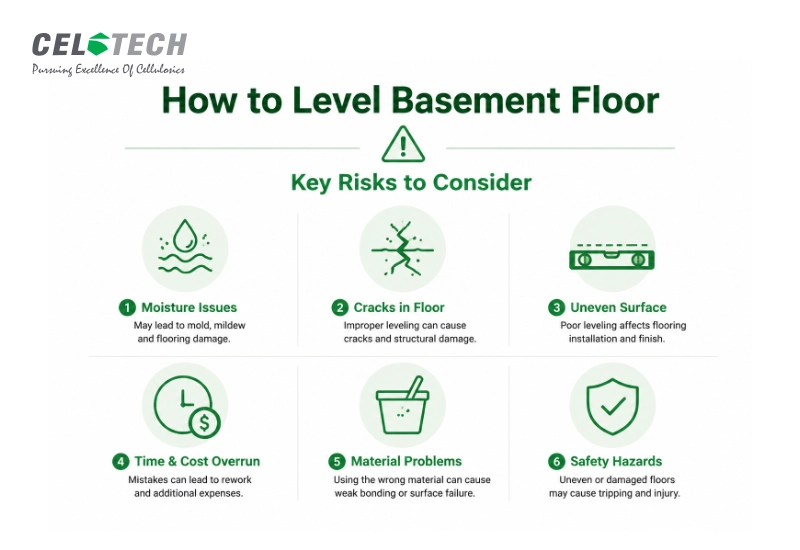
4. Basement failure risks
Most basement floor leveling failures are not caused by applications, but by environmental and material system incompatibility.
4.1 Vapor pressure issues
Moisture vapor from below slab can create:
- Blistering
- Surface delamination
- Long-term adhesion failure
4.2 Adhesion failure due to moisture
If substrate moisture is not properly managed:
- Bonding interface weakens
- Leveling layer separates from concrete
- Long-term durability is compromised
4.3 Cracking from slab movement
Basement slabs may continue micro-movement over time:
- Structural settlement
- Thermal expansion differences
- Moisture-related expansion/contraction
Rigid leveling systems may develop reflective cracking if flexibility is insufficient.
5. Basement-specific leveling workflow
This section focuses only on steps that differ from standard floor leveling.
Step 1: Moisture testing (critical baseline condition)
Before any application:
- Evaluate slab moisture condition
- Identify vapor transmission risk
- Assess humidity stability
This determines system selection strategy.
Step 2: Sealing and primer adjustment
Based on substrate condition:
- Apply appropriate primer system for aged concrete
- Stabilize surface absorption rate
- Improve bonding interface consistency
Primer performance is especially important in basement environments due to moisture variability.
Step 3: Adjusted self-leveling application strategy
Basement conditions often require as below, System stability is more important than application speed.
- Moisture-tolerant leveling systems
- Controlled layer thickness design
- Stable flow performance under humidity variation
- Careful control of mixing and application timing
Final takeaway
Basement floor leveling is not a general construction task—it is a moisture-sensitive concrete system engineering problem.
Success depends on:
- Managing below-slab moisture influence
- Stabilizing aged concrete substrates
- Ensuring primer compatibility
- Maintaining self-leveling stability under humidity variation
From a materials perspective, long-term performance is determined by: water retention control, adhesion system stability, and rheology balance under real basement conditions.
More Reading:
How to Level a Concrete Floor Without Failures: Step-by-Step Contractor Guide