
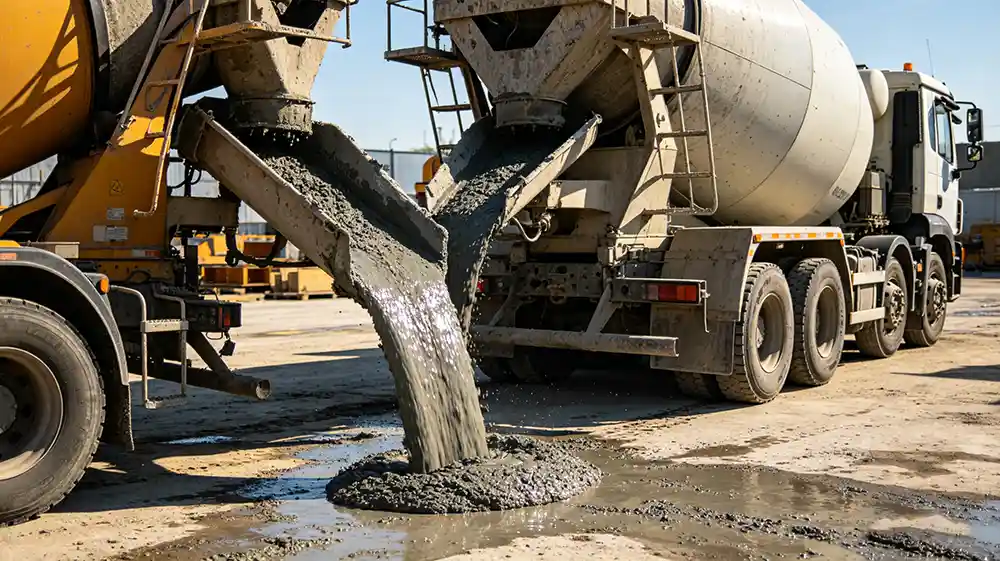
If you have ever been involved in concrete construction or mix design, you have likely encountered a very practical dilemma:
To make concrete easier to work with (more workable), you must add water; however, if you add too much water, the concrete’s strength will suffer.
This inherent conflict has persisted throughout almost the entire history of concrete technology development.
Eventually, a method was discovered that offered a “compromise—or even an optimization”—the use of superplasticizers.
Their function is simple, yet absolutely critical:
- They make concrete smoother and easier to place without the need to add any extra water.
- These materials are also commonly referred to as High-Range Water Reducers (HRWRs) and have now become a fundamental component of high-performance concrete.
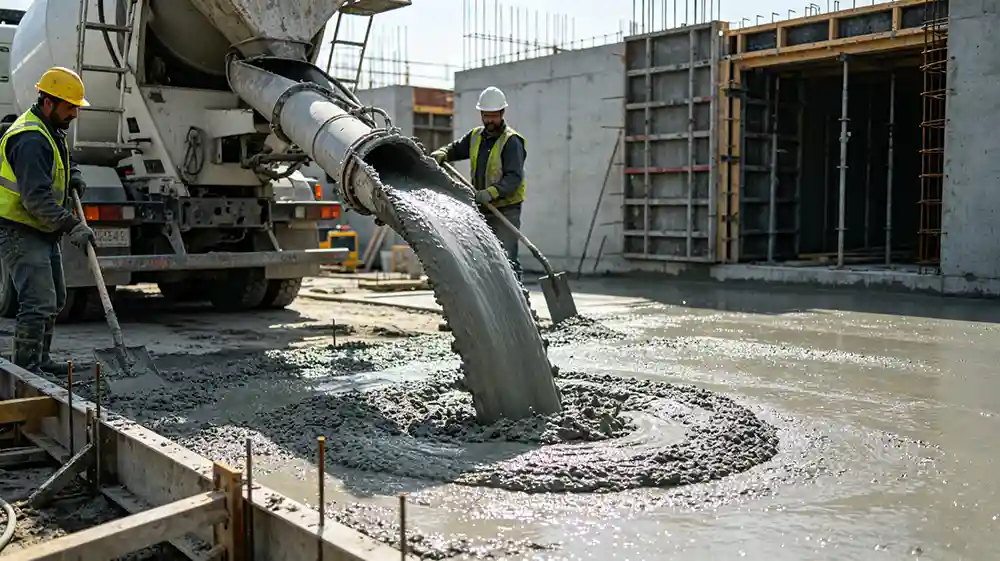
What Are Superplasticizers?
To put it in plain, straightforward terms:
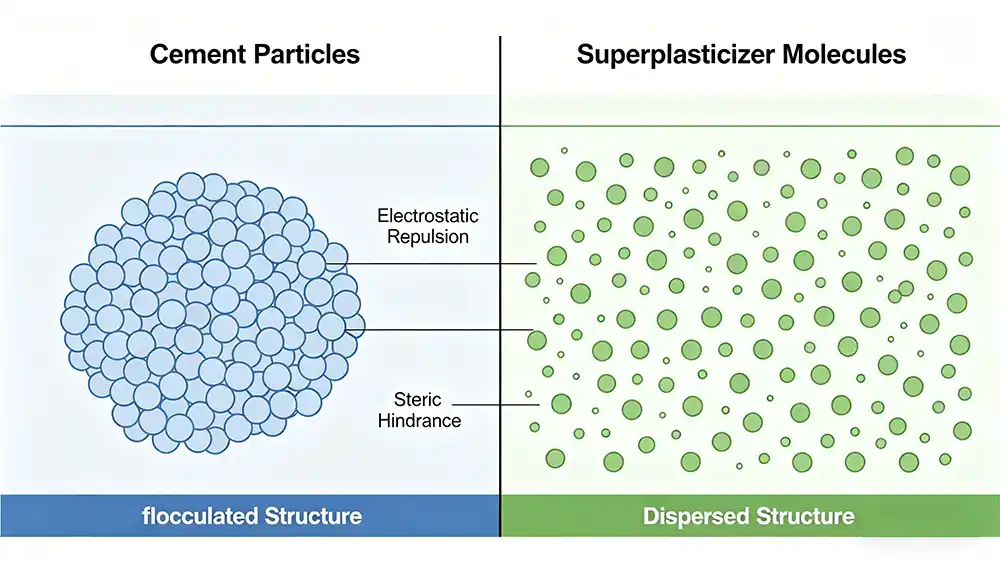
A superplasticizer is a chemical additive that prevents cement particles from sticking together.
Left to their own devices in water, cement particles tend to clump together, forming a “flocculated structure.” This traps water within the clumps, making the concrete mix dry and difficult to flow.
The role of a superplasticizer is to effectively “separate” these particles.
There are three common types:
Naphthalene-based (NS): A more traditional type.
Melamine-based (MS): Offers moderate performance.
Polycarboxylate-based (PCE): Currently, the most mainstream and advanced type available.
So, how exactly do they work?
From an intuitive standpoint, superplasticizers essentially perform three distinct actions.
Action 1: “Coating” the Cement Particles
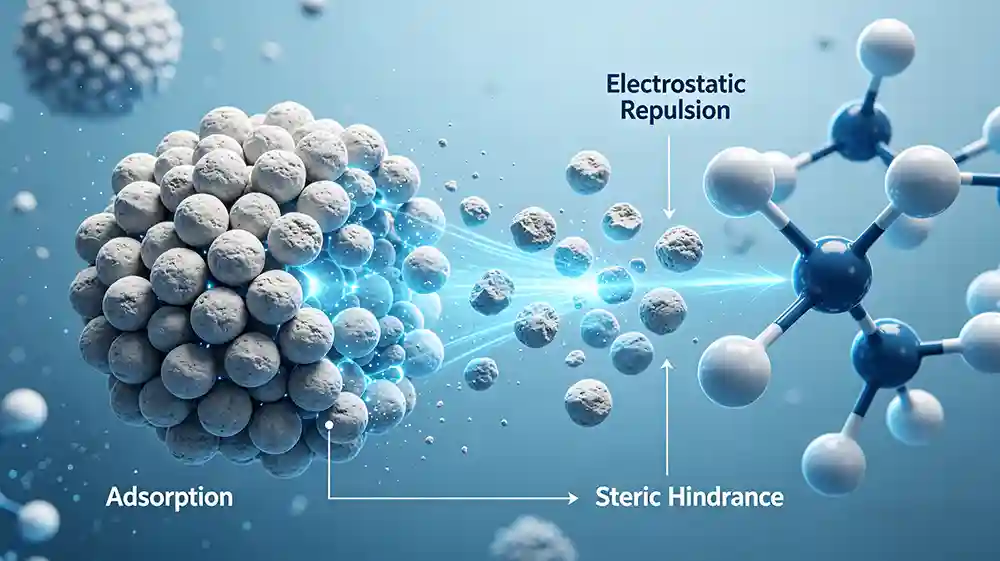
When a superplasticizer is added to the concrete mix, its molecules first adsorb—or attach—to the surface of the cement particles.
You can visualize this process as:
Each individual cement particle is being “fitted with a protective coating.”
This step is crucial, as it serves as the foundation for all subsequent changes.
Research (Tandırlı E., Akalın Ö., Arca E., 2000) has indeed confirmed that this “adsorption effect” is the fundamental mechanism by which superplasticizers exert their influence.
Action 2: Causing Particles to “Repel Each Other”
After adsorption, the particles’ surfaces acquire the same electrical charge.
The result is this:
Like charges repel one another.
You can imagine it as a crowd of people who were originally packed tightly together, suddenly beginning to “push each other away.”
It is at this stage that the workability—or flow—of the concrete begins to improve significantly.
Action 3: The Key Advantage of PCE—”Creating Space”
Traditional naphthalene-based and melamine-based admixtures rely primarily on “electrostatic repulsion.”
Polycarboxylate ether (PCE), however, differs; it has an even more critical mechanism: steric hindrance.
Simply put, it works like this:
Its molecular structure is quite long—extending outward like “tree branches”—and it physically pushes the cement particles apart, creating a distinct separation between them.
Consequently, even if the electrostatic forces diminish, the particles are prevented from clumping back together.
This is precisely why PCE remains highly effective even at low dosage rates.
What Distinguishes the Different Types of Superplasticizers?
From an engineering perspective, the differences can be understood as follows:
Naphthalene-based (NS)
Relatively “direct” in action, relying mainly on electrostatic forces; however, it is quite sensitive to variations in cement composition, sometimes resulting in inconsistent performance.
Melamine-based (MS)
Generally well-balanced, offering decent early-stage performance, though its scope of application is relatively limited.
Polycarboxylate-based (PCE)
A more “intelligent” design that utilizes both electrostatic forces and steric hindrance to control particle dispersion, thereby delivering superior stability and efficiency.
How Does It Affect Concrete Strength?
This is a question frequently raised in engineering practice.
The answer, in truth, is: it has both positive and negative aspects, depending on how you look at it.
The Upside
If the cement particles are dispersed more uniformly:
- The cement undergoes more complete hydration.
- The resulting structure is denser.
- Both long-term strength and durability are enhanced.
Points to Note
However, in certain situations, it may cause the “early-stage reaction to slow down slightly.”
The reason is that the admixture may adsorb onto the more reactive components within the cement—such as C₃A and C₃S—thereby slightly delaying their hydration reactions.
This phenomenon has also been observed in various research studies.
Therefore, it is best understood in this way:
It does not “weaken the concrete,” but rather “alters the *pace* at which it gains strength.”
What Happens at the Microscopic Level?
If we zoom in on concrete to the microscopic realm, we can observe three primary structural components:
- Unhydrated cement particles
- Calcium hydroxide crystals
- C-S-H gel (the component that ultimately determines the concrete’s strength)
Following the addition of a superplasticizer, the most striking changes are:
The cement particles are distributed more uniformly; the formation of C-S-H gel becomes more continuous; and the volume of voids (empty spaces) is significantly reduced. In terms of results, it simply means the concrete becomes more “compact.”
Why is PCE becoming increasingly mainstream?
The growing use of PCE in modern engineering projects is not merely because it is “new,” but rather because it offers greater “stability.”
Its key advantages include:
- Achieving the same level of fluidity with a lower dosage.
- Extended slump retention time.
- Greater compatibility with various cement systems.
- Better suitability for modern high-performance concrete systems.
In actual industrial practice, material manufacturers specializing in molecular design (such as Celotech) are also pursuing optimization in this direction:
By fine-tuning the molecular structure of PCE, they aim to enhance its compatibility with diverse cement systems.
To summarize the function of a superplasticizer in a single sentence:
It does not “add water,” but rather “rearranges the state of the cement particles.”
It primarily operates through three mechanisms:
1. Adsorption.
2. Electrostatic repulsion.
3. Steric hindrance (a mechanism unique to PCE).
The ultimate results are:
- Improved workability
- A more uniform structure
- More controllable strength development
Learn More
1. What Exactly Does a Superplasticizer Do?
Its primary function is to enhance the fluidity (workability) of concrete without increasing the water content.
2. Does it Affect Concrete Strength?
Generally, it does not affect the ultimate strength; however, it may cause the early-stage strength development to proceed slightly more slowly.
3. Why is PCE Superior to Traditional Water Reducers?
In addition to electrostatic effects, it also utilizes its “spatial structure” to facilitate particle dispersion.
4. Can it Be Used with All Types of Concrete?
It is compatible with most concrete mixtures, though the effectiveness may vary depending on the specific cement system used.
References
Effects of Different Superplasticizers on Early Strength of Concrete