
In mortar formulation and application, several time-related parameters are often discussed. Among them, the most common are setting time, pot life, and open time.
1. Setting Time
The setting time of cement is generally divided into two stages: the initial setting time and the final setting time.
Initial setting time refers to the period after mixing cement with water when the paste begins to lose its plasticity.
Final setting time refers to the time required for the cement paste to completely lose its plasticity and start to develop strength.
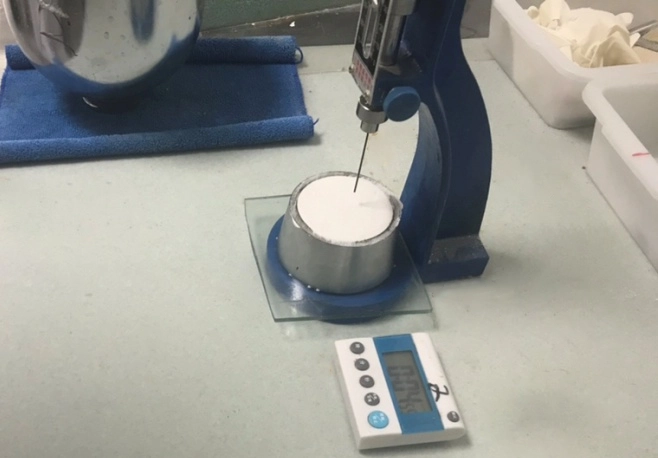
Testing equipment: Vicat apparatus is usually used to test the initial and final setting time of mortar
To achieve faster setting and improved early strength, additives such as Celotech Quickset S98 (calcium formate) can be used. It promotes cement hydration and is particularly suitable for CTA, 3D-printed mortars, and renders, where early performance is critical.
2. Pot Life
Pot life refers to the maximum period during which the mortar remains workable after being mixed with water.
As hydration progresses, the workability of the mortar gradually decreases. Pot life is closely related to setting time — generally, a longer setting time corresponds to a longer pot life.
To extend pot life, a retarder can be added or the dosage of cellulose ether can be increased, helping to slow down hydration and maintain better workability during application.
3. Open Time
Open time differs from setting time and is mainly relevant for tile adhesives.
For example, if the open time is specified as 20 minutes, it means that tiles applied within 20 minutes can still achieve a tensile adhesion strength greater than 0.5 MPa, according to standard test methods.
The complete testing process typically takes 28 days, but a quick evaluation method is often used in practice:
Apply tile adhesive on a concrete board, then set tiles after 10, 15, 20, 25, 30, 35, and 40 minutes. Apply a 3 kg load for 30 seconds, remove the tile, and check the wetting area.
The open time is defined as the longest interval at which the wetting area remains above 50%.
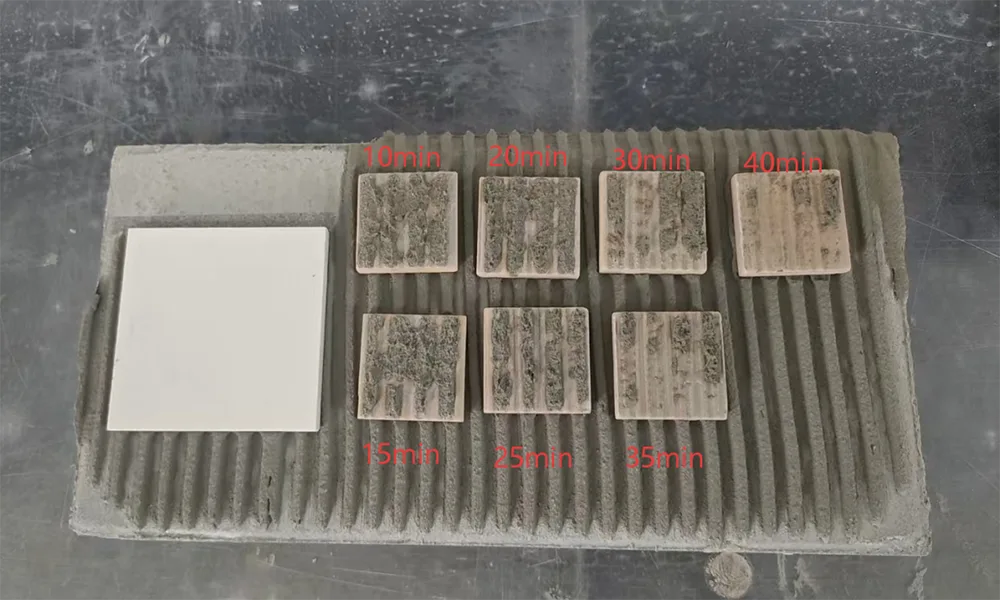
From the test results shown, the tile adhesive maintains a wetting area greater than 50% for more than 30 minutes, indicating a long open time.
Several factors can influence open time, including the formulation, cellulose ether, starch ether, and cellulose fiber content.
Products such as Celopro cellulose ether, Vinabond RDP, Stargel starch ether, and Celofiber cellulose fiber can help optimize the formulation and effectively improve open time.