
Polypropylene fiber is widely used for concrete reinforced since its high performance on chemical resistance and thermal stability . Its can improve the durability of concrete and mortar from the inside out significantly. today, we will have a deep analysis on why the PP fiber is necessary for concrete/cement on strength quality and crack resistance.
Why Use Polypropylene Fiber for Concrete?
Concrete or cement, as a binding material, has good workability, and hardened concrete has high compressive strength. In the centuries, concrete will still be the most widely used building material in human society, but as a base construction material, concrete also inherently has serious defects as below:
- Low tensile strength, far lower than its compressive strength;
- Poor impact resistance, it is a typical brittle material, namely cast iron material;
- Poor crack resistance, there are a large number of shrinkage cracks and temperature cracks in the components, which will continue to change and develop over time. Fine cracks will eventually develop into large cracks.
Cement-based materials, such as mortar and concrete, has these problems are innate and inherent. Especially poor shrinkage crack, If the shrinkage is large, it is easy to produce a large number of cracks, and the ratio of tensile strength to compressive strength is small, only 6%, which is significant and has low plasticity.
As the compressive strength of cement substrate increases significantly, the problems of dry shrinkage and brittleness become more prominent, and brittle failure is prone to occur.
The Types of Polypropylene Fiber for Concrete
The most direct and effective way to overcome the defects of concrete or cement and its products is to incorporate fibers into the cement substrate.
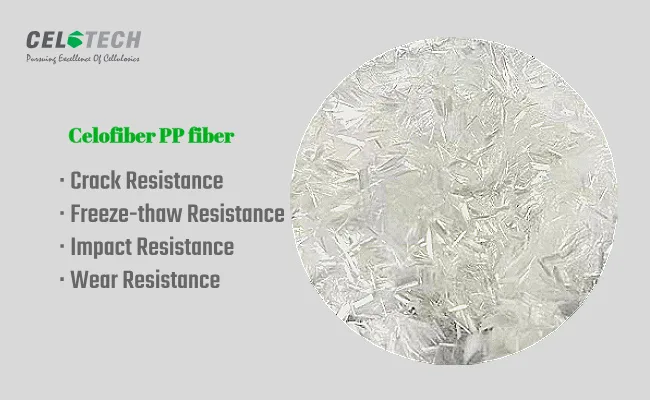
Adding various fibers to dry mixed mortar is an important means to improve its crack resistance, enhance its resistance to cracking, freeze-thaw resistance, impact resistance, and wear resistance. It is also an important measure to improve the overall performance of mortar.
Below are some fibers types you can mix with concrete to reinforce concrete property:
Divided by Physical Form:
- PP monofilament Fiber: it’s appearance like hair, extremely fine, with an exceptionally high number of fibers per kilogram. Mostly used in drymix mortar, wall putty, and plastering gypsum. It effectively improves surface crack ability and imparts a smooth, refined finish to the construction coating.
- PP mesh fiber: It looks like a flat ribbon form and expands into a three-dimensional “fishnet”-like structure after mixingwhen it is manufactured; it can make grip stronger by mixing concrete and provides superior lateral support; It mostly used in concrete pavements, industrial flooring, and shotcrete applications.
Divided by Scale & Function:
- PP micro-fibers: It’s length usually shorter than3mm, and specialized to repair the plastic cracks which is occurred before the concrete dry totally.
- PP macro-fibers: It’s length usually longer than 0.3mm, it often used to replace the steel fiber or light steel wire mesh. It applied into prefabricated components, tunnel lining system, heavy-duty industrial flooring.
Divided by Surface Treatment:
- Hydrophilic PP fiber: Surface-treated (e.g., with sizing agent) for rapid dispersion in water, preventing clumping.
- Non-hydrophilic fiber:Requires longer mixing time to disperse effectively.
Below is the compare sheet about different fibers:
| Fiber Type | Length | Main Application | Core Value |
| Monofilament PP fiber | 3mm – 19mm | Drymix mortar, Rendering, Wall putty | Crack control, Smooth finish |
| Fibrillated (Mesh) PP fiber | 12mm – 50mm | Pavement, Industrial flooring | High bond, Impact resistance |
| Macro PP Fiber | 30mm – 60mm | Precast components, Shotcrete | Replace steel mesh, Structural integrity |
What are Polypropylene (PP) Fiber Properties?
If the fibers are uniformly and randomly distributed in the concrete mortar matrix, the fibers will have a certain limiting and hindering effect on the propagation of microcracks when the cement mortar is subjected to external or internal stresses. Billions of fibers crisscross, isotropic, and evenly distributed, just like hundreds of millions of “micro steel bars” implanted in the matrix of cement mortar. This makes the expansion of cracks hindered by the fibers, and micro cracks cannot continue to develop beyond these fibers, but can only detour along the interface between the fibers and the cement matrix. The generation and propagation of cracks require a certain amount of energy, and the energy generated by stress caused by various reasons in the mortar matrix will be exhausted due to the presence of a large number of fibers.
Technical Requirement (GB/T 21120-2018 Synthetic fibers for cement concrete and mortar), take your a reference for the different fiber application in concrete and in drymix mortar.
| Item | In concrete | In mortar | ||
| HF | HZ | SF | ||
| PP fiber | Tensile strength/ MPa ≥ | 350 | 500 | 270 |
| Elasticity modulus/MPa ≥ | 3000 | 5000 | 3000 | |
| Crack elongation/ % ≤ | 40 | 30 | 50 | |
| Resistance to Alkali/% ≥ | 95.0 | |||
| PP macro fiber | Tensile strength/ MPa ≥ | —- | 400 | —- |
| Elasticity modulus/MPa ≥ | —- | 5000 | —- | |
| Crack elongation/ % ≤ | —- | 30 | —- | |
| Resistance to Alkali/% ≥ | 95.0 | |||
If you are looking for different fiber to reinforce the concrete stability and compressive strength, Celotech’s fiber list as below, our fibers are manufactured and tested by international standards, you can check the technical sheet to choose the right one for your project, if you have any more technical request, you can ask our technical specialist in filling the inquiry form, we will respond the email when we got the message.
Selection Guide for Our products:
Celofiber PP fiber:
| Synthetic | Grade | Length |
| PP fiber | Celofiber PPL3 | 3mm |
| Celofiber PPL6 | 6mm | |
| Celofiber PPL9 | 9mm | |
| Celofiber PPL12 | 12mm | |
| PP macro fiber | Celofiber PPM3 | 30mm |
| Celofiber PPM4 | 40mm | |
| Celofiber PPM5 | 50mm | |
| Celofiber PPM6 | 60mm |
Our Celofiber® PP Macro Fiber price is reasonable and if you want more info for the polypropylene fiber concrete mix design, it can replace steel wire mesh improve crack resistance. our lab can make it accordingly and send you free sample for your testing before you changing the supplier.
More Readings:
The Development Status of Cellulose Fiber Market
Application of cellulose fiber in the construction field
