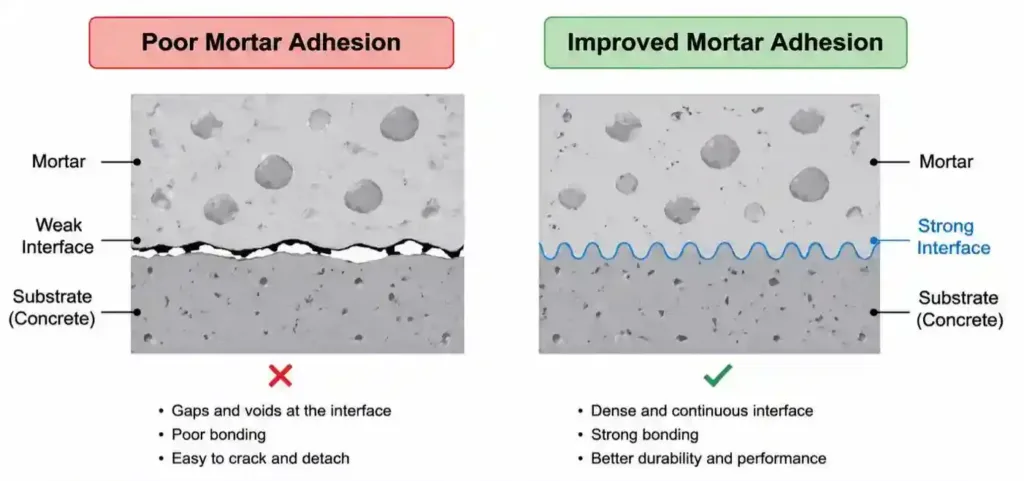
In masonry and tile installation, many common construction defects—such as cracking, hollow tiles, water penetration, or reduced durability—can often be traced back to poor mortar adhesion. Proper bonding between mortar and substrate is essential for long-term performance and durability. Effective mortar adhesion is critical for stone, brick, and tile installations, whether using adhesive mortar for tiles or mortar glue for bricks.
From a materials perspective, mortar adhesion depends on several key factors including surface condition, mix design, water retention, and the use of functional additives.
Common Reasons for Poor Mortar Adhesion
Based on practical experience in dry-mix mortar formulations, the following factors are frequently responsible for poor bonding performance:
- Poor substrate preparation
Dust, oil, or loose particles can significantly reduce the bonding interface between mortar and substrate. Proper cleaning and roughening of the substrate are essential to ensure mechanical interlocking. (ASTM C270 – Standard Specification for Mortar for Unit Masonry) - Improper water content
Too much water weakens mechanical strength, while insufficient water reduces workability and prevents proper cement hydration. Maintaining the correct water ratio is critical for both workability and bond strength. - Rapid water loss
High temperatures, wind, or highly absorbent substrates can cause mortar to lose water too quickly, leading to surface shrinkage and poor adhesion. Controlled curing conditions can prevent this issue. - Inadequate mortar formulation
Traditional cement-sand mortar may lack sufficient adhesion and flexibility without proper additives. This is especially critical when working with tiles, stone, or brick installations.
Practical Approaches to Improve Mortar Adhesion
Modern construction materials use a combination of process control and optimized formulations to enhance adhesion. Key strategies include:
1. Surface preparation: The substrate should be clean, stable, and slightly rough to improve mechanical bonding. For example, in recent tile and brick projects, lightly sandblasting concrete surfaces before installation has consistently reduced hollow tiles and debonding.
2. Optimized mix design: High-quality cement, properly graded sand, and controlled water ratios are essential, it can improve both workability and bond strength. Dry-mix mortar formulations are often designed to balance flowability and adhesion to prevent sagging on vertical surfaces.
These optimized mixes are suitable for adhesive mortar for stone, mortar glue for bricks, and adhesive mortar for tiles.
3. Controlled curing conditions: Preventing rapid drying helps ensure proper cement hydration and bonding strength. In practical conditions, even small adjustments to curing (e.g., shading tiles from direct sun for the first 24 hours) have reduced cracking and delamination issues.
4. Use of functional additives: Today, most high-performance dry-mix mortars include additives such as:
- Cellulose Ether (HPMC / HEMC) – enhances water retention and workability, ensuring mortar stays workable longer for larger installations.
- Redispersible Polymer Powder (RDP) – improves adhesion, flexibility, and reduces debonding risks on challenging substrates.
- Polycarboxylate Superplasticizers – improve workability while reducing water demand, allowing higher strength and better bonding.
- Calcium Formate – accelerates setting and improves early strength, particularly useful in cold weather or time-sensitive projects.
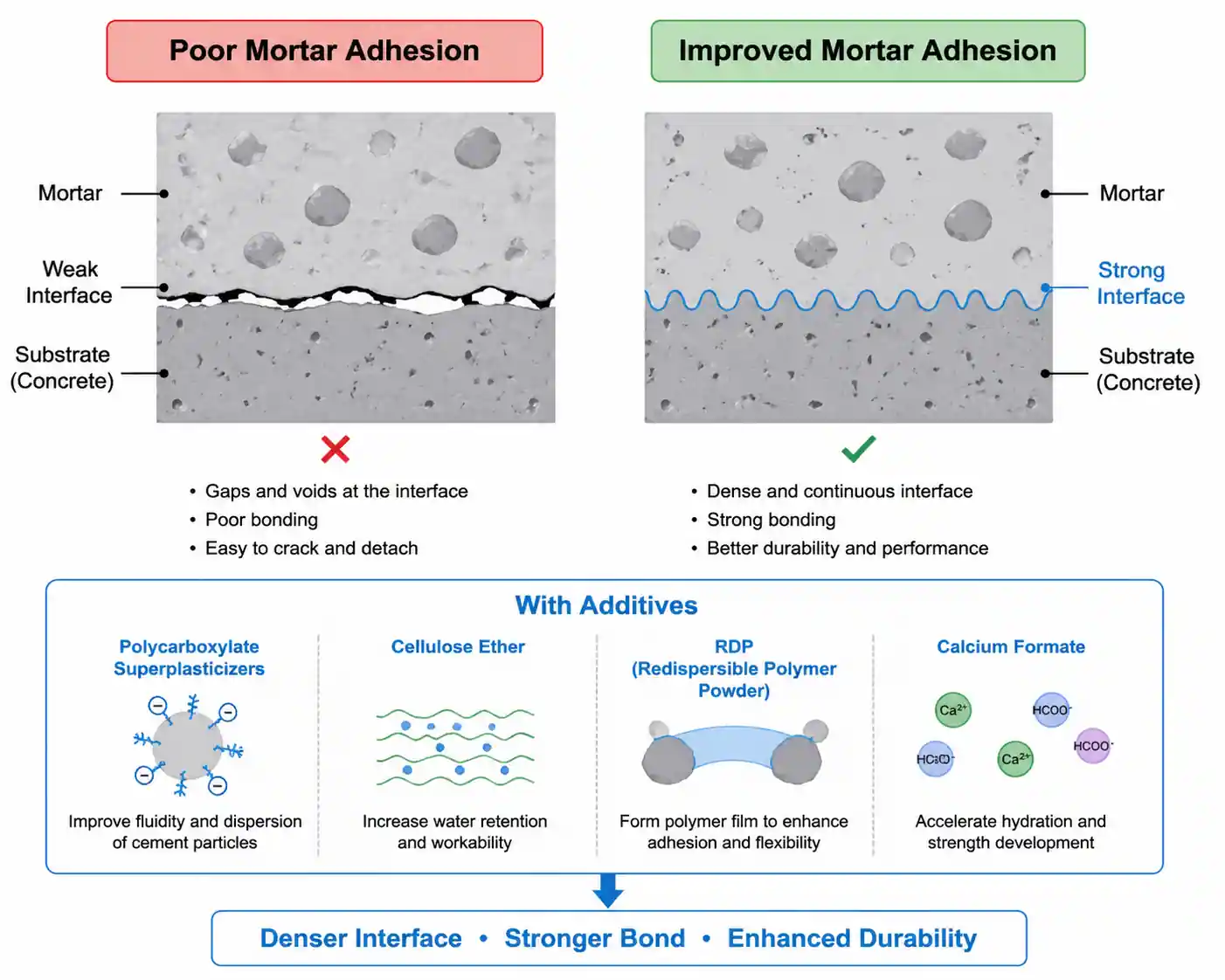
Application example: In European masonry projects, adding HPMC and RDP to tile adhesive mortars and outdoor brick adhesive has been reported to reduce delamination incidents on large-format tiles and stone cladding. Among these, cellulose ethers and RDP are particularly critical for preventing common defects and improving long-term adhesion. These additives are also widely applied in best concrete bonding agents for structural and exterior masonry applications.
Final Thoughts
As construction standards continue to rise, traditional mortar formulations are gradually being replaced by performance-optimized dry-mix systems.
By combining proper surface preparation, controlled mix design, and modern construction additives, manufacturers and contractors can significantly improve adhesion, durability, and overall construction quality.
For contractors, producers, and project engineers looking for optimized adhesive mortar solutions—including mortar plasticizers, high-performance bonding agents, and outdoor brick adhesives—these approaches ensure both durability and reliable construction outcomes.
Frequently Asked Questions (FAQ)
Q1: How is adhesive mortar for stone applied to heavy stone panels?
A1: Adhesive mortar for stone is designed to provide strong mechanical and chemical bonding for heavy stone units.
Q2: What are the best practices for using mortar glue for bricks in wall construction?
A2: Mortar glue for bricks is suitable for masonry walls and requires a clean, stable, and slightly rough substrate. Consistent water ratio and careful curing help achieve uniform adhesion and prevent cracking or debonding. This type of adhesive works well in both indoor and moderately exposed environments.
Q3: Why choose adhesive mortar for tiles for large-format tiles?
A: Adhesive mortar for tiles is formulated for thin layers and large-format tiles, offering smooth application, flexibility, and reliable bonding. Using functional additives ensures the mortar maintains workability during installation and reduces the likelihood of hollow tiles or delamination.
Q4: What are typical applications for mortar plasticizers in dry-mix mortar?
A: Mortar plasticizers improve workability without increasing water content, enhancing bond strength and flow. They are commonly used in dry-mix mortars for walls, tiles, and stone applications.
Q5: How are best concrete bonding agents used in renovation or repair projects?
A: Best concrete bonding agents enhance adhesion between new and existing concrete, making them ideal for renovation, repair, or overlay projects. They help ensure durability and structural integrity, particularly in areas where traditional mortar may have insufficient bonding.
Q6: What considerations are important when using outdoor brick adhesive in weather-exposed areas?
A: Outdoor brick adhesive must withstand temperature fluctuations, moisture, and wind. Proper substrate preparation, use of high-performance adhesive mortars, and additives like RDP or HPMC improve adhesion and long-term durability in exterior masonry applications.