
Table of Contents
Quick Answers
Why Are Garage Floors Usually Not Level?
Inspect the Garage Floor Before Leveling
How Flat Should a Garage Floor Be?
Which Garage Floor Leveling Method Should You Choose?
Best Methods to Level a Garage Floor
How to Use Self-Leveling Compound on a Garage Floor
What Materials Are Used in Garage Floor Leveling Compounds?
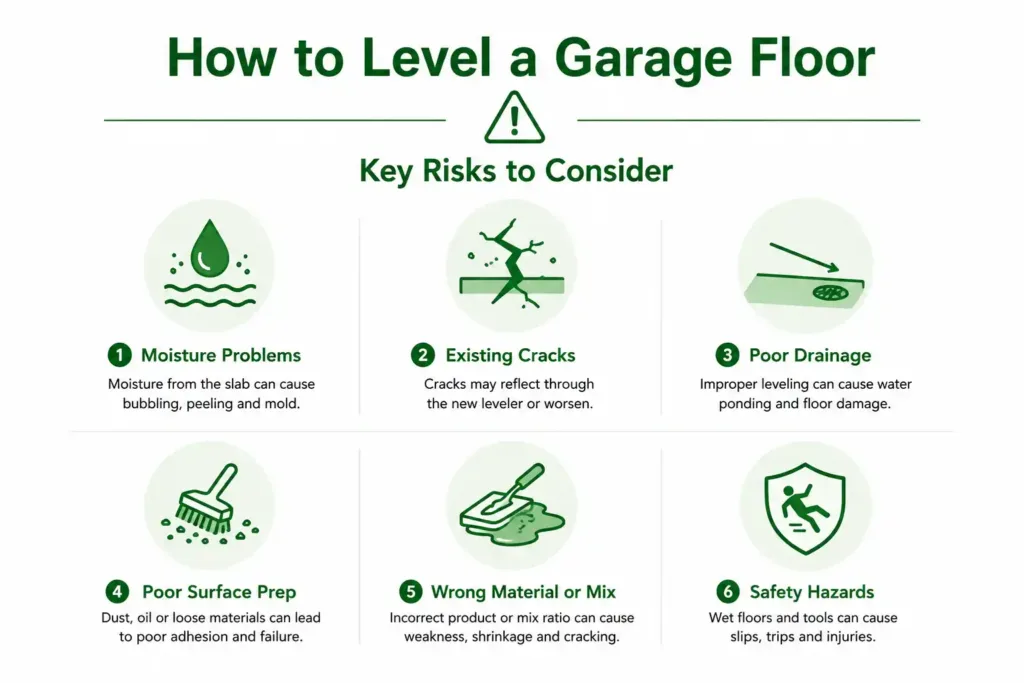
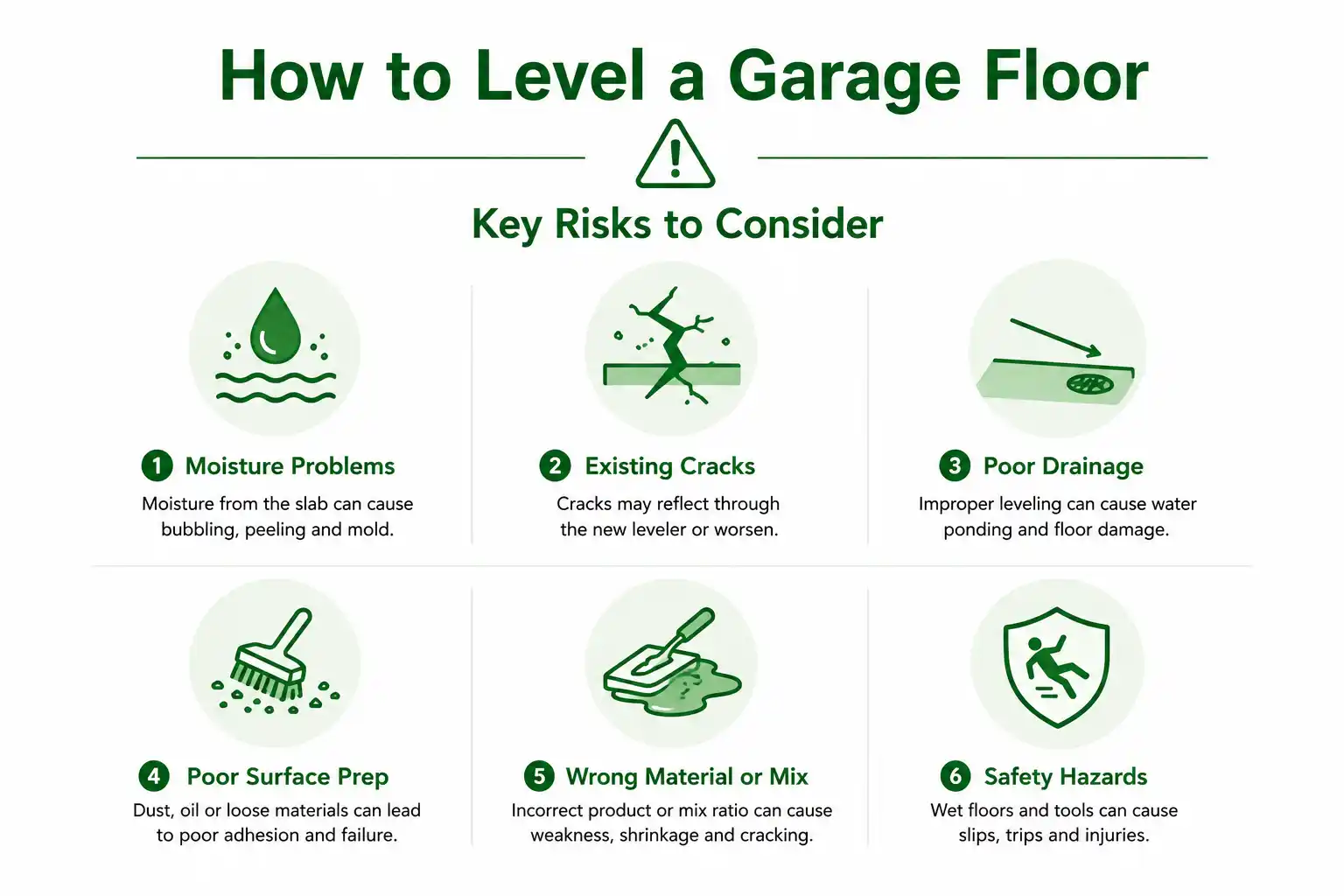
Why Garage Floor Leveling Projects Fail
Common Garage Floor Leveling Mistakes
Expert Recommendations for Garage Floor Leveling
Can You Apply Epoxy After Leveling a Garage Floor?
Garage Floor Leveling FAQs
Conclusion
Garage floors are rarely perfectly level. Most are intentionally built with a slight slope toward the garage door to improve drainage and prevent water accumulation.
However, excessive unevenness, settlement, cracks, or low spots can create safety hazards, interfere with floor coatings, and make it difficult to install cabinets, workbenches, storage systems, or vehicle lifts.
This guide explains when a garage floor should be leveled, how to identify the cause of unevenness, the best leveling methods, materials used in modern leveling compounds, and the most common reasons leveling projects fail.
Quick Answers
Can you level a garage floor with self-leveling compound?
Yes. Self-leveling compound can correct minor unevenness, low spots, and surface imperfections on garage floors. Most products are suitable for repairs up to 1–1.5 inches (25–38 mm) deep, although thicker applications may require aggregate extension or multiple lifts.
Are garage floors supposed to be level?
Not always. Most residential garage floors are intentionally sloped toward the garage door to facilitate drainage and prevent standing water.
What is the best way to level a garage floor?
The best method depends on the severity and cause of the unevenness. Minor low spots can often be repaired with self-leveling compound, while sunken slabs may require slab jacking or polyurethane foam lifting.
Can you apply epoxy after leveling a garage floor?
Yes. A properly leveled surface improves coating adhesion, appearance, and long-term durability for epoxy and polyaspartic floor systems.
Why Are Garage Floors Usually Not Level?
Many homeowners assume a garage floor should be perfectly level. In reality, most garages are intentionally built with a slight slope.
Garage Floors Are Designed for Drainage
A typical garage floor slopes toward the garage door to allow water from rain, snow, and vehicle runoff to drain away.
Common slopes range from:
- 1/8 inch per foot
- 1/4 inch per foot
This helps:
- Prevent standing water
- Reduce moisture damage
- Improve drainage
- Protect stored items
A sloped floor is often a design feature rather than a construction defect.
When Is Leveling Necessary?
Leveling may be required when:
- Water pools in low spots
- The concrete slab has settled
- Adjacent slab sections are uneven
- Cracks create trip hazards
- Epoxy coating is planned
- A vehicle lift is being installed
- The garage is being converted into living space
Inspect the Garage Floor Before Leveling
Before selecting a repair method, determine whether the problem is a surface irregularity or a structural issue.
Measure High and Low Spots
Use:
- Laser level
- Straightedge
- Spirit level
Record:
- Maximum height difference
- Locations of low spots
- Drainage direction
- Crack locations
Accurate measurements help determine the most suitable repair method.
Determine Whether the Problem Is Structural
Surface irregularities can usually be corrected with leveling compounds.
However, large slab settlement may require:
- Slab jacking
- Mud jacking
- Polyurethane foam lifting
- Foundation repair
A leveling compound cannot stop ongoing structural movement.
How Flat Should a Garage Floor Be?
Before attempting to level a garage floor, it is important to understand the difference between a floor that is intentionally sloped and one that is excessively uneven.
| Measurement | Typical Value |
|---|---|
| Garage drainage slope | 1/8–1/4 inch per foot |
| Height difference across a 20-foot garage | 2–4 inches |
| Acceptable floor variation | Less than 1/4 inch over 10 feet |
| Typical self-leveling compound thickness | 3–38 mm |
| Vehicle traffic curing time | 24–72 hours |
In most cases, eliminating dangerous low spots and abrupt elevation changes is more important than creating a perfectly level floor.
Which Garage Floor Leveling Method Should You Choose?
The best repair method depends on the severity of the floor unevenness and its underlying cause.
| Garage Floor Condition | Recommended Solution |
|---|---|
| Minor low spots under 1 inch | Self-leveling compound |
| Multiple shallow depressions | Cementitious overlay |
| Isolated high spots | Concrete grinding |
| Sunken slab sections | Slab jacking |
| Ongoing settlement | Foundation repair |
| Preparing for epoxy coating | Grinding + leveling compound |
In many situations, grinding high areas before filling low spots can significantly reduce material consumption and improve final flatness.
Best Methods to Level a Garage Floor
Method 1: Self-Leveling Compound
Best for:
- Minor unevenness
- Low spots
- Surface imperfections
- Floor preparation before epoxy
Advantages:
- Fast installation
- Smooth finish
- Good flowability
- Compatible with floor coatings
Limitations:
- Higher material cost
- Thickness limitations
- Requires careful surface preparation
Method 2: Concrete Overlay
Best for:
- Large repair areas
- Multiple low spots
- Moderate elevation changes
Advantages:
- Durable
- Cost-effective for larger projects
- Suitable for vehicle traffic
Concrete overlays are often more practical than self-leveling compounds when thickness requirements become significant.
Method 3: Concrete Grinding
Best for:
- Isolated high spots
- Surface transitions
- Preparing for floor coatings
Grinding often reduces the amount of leveling material required.
Method 4: Slab Jacking
Best for:
- Sunken garage slabs
- Settlement-related problems
Advantages:
- Preserves existing slab
- Minimal demolition
- Faster than replacement
This method lifts the concrete rather than covering the problem.
How to Use Self-Leveling Compound on a Garage Floor
Self-leveling compounds are among the most common solutions for correcting minor garage floor unevenness.
Step 1: Clean the Surface Thoroughly
Remove dust, dirt, oil, grease, paint, sealers, Contaminants can prevent proper bonding.
Step 2: Repair Cracks and Holes
Seal the large cracks, expansion joints (if required), penetrations andvoids.
This prevents material loss during pouring.
Step 3: Apply Primer
Primer helps improve adhesion, reduce substrate absorption, improve leveling performance and minimize pinholes to skip primer is one of the most common causes of failure.
Step 4: Mix According to Instructions
Follow the manufacturer’s water ratio exactly will avoid overwatering, inconsistent mixing and extended mixing times.
Improper mixing can reduce strength and affect flow characteristics.
Step 5: Pour and Spread Quickly
Most self-leveling compounds have a limited working time.
Use gauge rake, squeegee, spiked roller to distribute material evenly and release trapped air.
Step 6: Allow Proper Curing
Avoid vehicle traffic until the material reaches the manufacturer’s recommended curing time.
Premature loading can damage the newly leveled surface.
What Materials Are Used in Garage Floor Leveling Compounds?
Modern self-leveling compounds contain a carefully balanced combination of ingredients designed to provide flowability, strength, adhesion, and durability.
Cement: Cement provides the primary strength and load-bearing capacity of the leveling layer.
Fine Aggregates: Graded sand improves dimensional stability and reduces shrinkage.
Cellulose Ether (HPMC) helps improve water retention, workabilit, open time, and application consistency to maintain a stable mixture during placement and reduces segregation.
Redispersible Polymer Powder (RDP) improves adhesion to concrete, flexibility, crack resistance and impact resistance.
It is particularly important in polymer-modified leveling systems.
Powder Defoamer help reduce entrapped air, improve surface smoothness, increase density and minimize pinholes.
Fibers help control shrinkage cracking, improve dimensional stability and enhance durability.
Why Garage Floor Leveling Projects Fail
Many leveling failures are caused by improper preparation rather than poor-quality materials.
Failure 1: Applying Over Oil-Contaminated Concrete
Oil and grease prevent proper adhesion.
Solution
Mechanically clean and profile the concrete before application.
Failure 2: Skipping Primer
Without primer, concrete can absorb water too quickly.
Result
- Poor bond strength
- Cracking
- Delamination
Solution
Always use the recommended primer.
Failure 3: Adding Too Much Water
Excess water can cause:
- Reduced strength
- Dusting
- Cracking
- Surface defects
Solution
Follow the specified mixing ratio.
Failure 4: Pouring Beyond Recommended Thickness
Most self-leveling compounds have depth limitations.
Solution
Use:
- Aggregate extension
- Multiple lifts
- Concrete overlays
for deeper repairs.
Failure 5: Ignoring Structural Settlement
Leveling products cannot stop foundation movement.
Solution
Address settlement issues before surface repairs.
Failure 6: Trying to Remove All Drainage Slope
Many garage floors are intentionally sloped.
Result
Removing all slope may create:
- Water accumulation
- Drainage problems
- Moisture-related issues
Solution:
Preserve necessary drainage whenever possible.
Common Garage Floor Leveling Mistakes
The following mistakes frequently lead to unsatisfactory results:
- Failing to identify the root cause of unevenness
- Using self-leveling compound for deep structural repairs
- Skipping surface preparation
- Ignoring manufacturer’s mixing instructions
- Pouring too slowly
- Attempting to create a perfectly flat floor where drainage is required
- Applying coatings before the leveling layer has fully cured
Avoiding these mistakes significantly improves long-term performance.
Expert Recommendations for Garage Floor Leveling
Successful garage floor leveling projects typically follow three key principles.
- Address the Cause Before the Symptom: Surface repairs are effective only when the underlying issue has been identified and corrected.
- Preserve Necessary Drainage Slopes: Not every garage floor should be completely level. Maintaining proper drainage is often more important than achieving absolute flatness.
- Use the Right Repair Method for the Right Depth: Self-leveling compounds perform best for minor to moderate corrections. Larger elevation differences are often better addressed through overlays or slab lifting methods.
Can You Apply Epoxy After Leveling a Garage Floor?
Yes. Many epoxy and polyaspartic coating systems perform better when applied over a smooth, properly leveled substrate.
Benefits include:
- Improved appearance
- Better adhesion
- More uniform coating thickness
- Enhanced long-term durability
Always verify that the leveling compound is fully cured before applying any coating system.
Garage Floor Leveling FAQs
Why are garage floors sloped?
Most garage floors are intentionally sloped toward the garage door to improve drainage and prevent water accumulation.
Should a garage floor be level or sloped?
A garage floor should generally maintain a slight drainage slope while minimizing excessive unevenness, trip hazards, and water pooling.
Can self-leveling compound be used on a garage floor?
Yes. Self-leveling compounds are commonly used to repair minor unevenness, low spots, and surface imperfections in garage floors.
How thick can self-leveling compound be applied?
Most products can be applied from a feather edge up to approximately 1–1.5 inches (25–38 mm), depending on the formulation.
What causes low spots in a garage floor?
Common causes include concrete settlement, poor finishing, soil movement, improper compaction, and long-term wear.
How do you fix a sunken garage floor?
Sunken slabs are often repaired using slab jacking, mud jacking, polyurethane foam lifting, or slab replacement.
Do you need primer before applying self-leveling compound?
Yes. Primer improves adhesion, reduces substrate absorption, and helps achieve consistent leveling performance.
Can epoxy be applied over a leveling compound?
Yes. Once the leveling compound has fully cured and meets the coating manufacturer’s requirements, epoxy can be applied successfully.
Conclusion
Leveling a garage floor begins with understanding whether the unevenness is caused by normal drainage design, surface irregularities, or structural settlement. While self-leveling compounds are highly effective for correcting minor imperfections, deeper depressions and sunken slabs may require overlays or lifting methods.
Proper inspection, surface preparation, material selection, and method selection are the key factors that determine the long-term success of any garage floor leveling project. For best results, choose a repair system that addresses both the visible symptoms and the underlying cause of the unevenness.
More Readings: How to Level a Concrete Floor Without Failures: Step-by-Step Contractor Guide